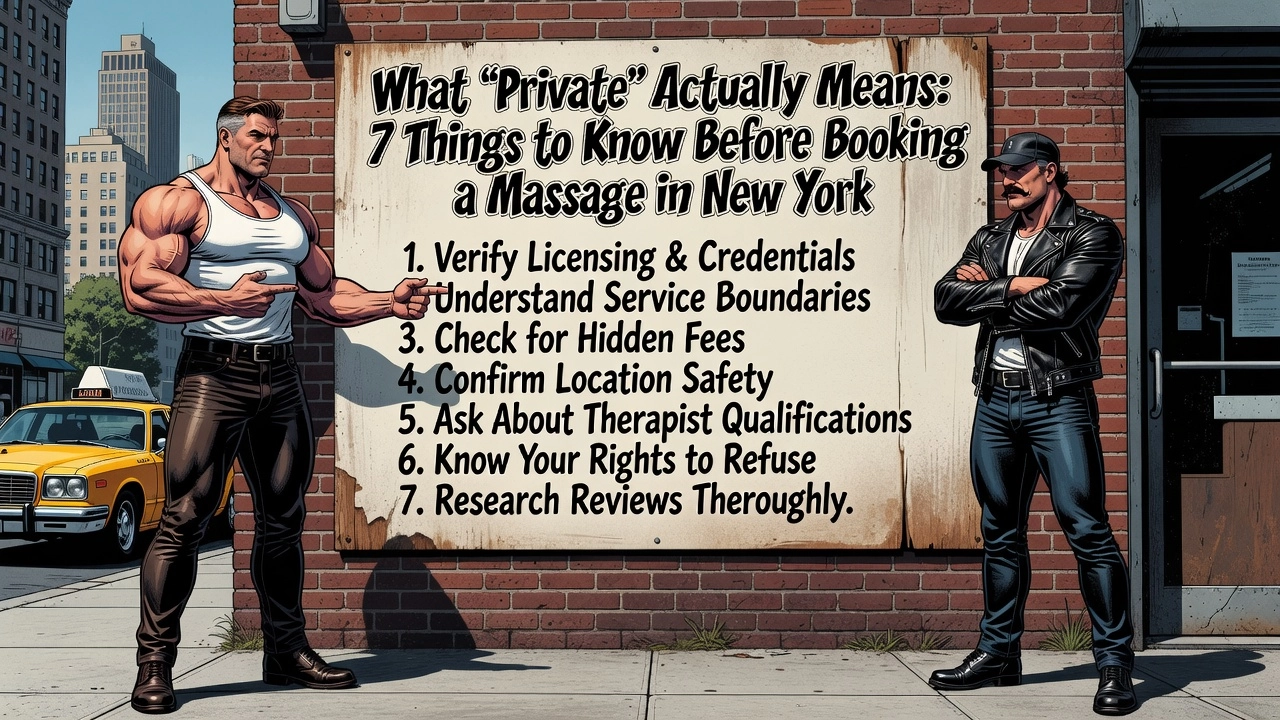
So you've been searching for a private massage in New York, and honestly, the options can feel overwhelming. Between the spa packages, the studio listings, and the occasional sketchy-sounding ad, it's hard to know what you're actually getting into before you book anything.
Here's the thing: the word "private" gets thrown around a lot in the wellness world, but it doesn't always mean the same thing. Sometimes it refers to the room setup. Sometimes it's about the therapist's credentials. And sometimes, well, it means something entirely different than what you'd expect from a legitimate massage experience.
Whether you're booking your very first massage or you're just new to navigating New York's busy wellness scene, this guide is here to help. We're breaking down seven important things you should know before you hand over your credit card or step into any treatment room. By the end, you'll feel confident, informed, and ready to find an experience that's safe, professional, and genuinely relaxing. Let's get into it.
A Private Suite Means No One Sees You Arrive or Leave
Let's start with the basics: a private suite is not just a room with a door that closes. It's a self-contained space where your entire visit, from the moment you step inside to the moment you leave, happens without crossing paths with other clients. No shared locker room. No communal waiting area where strangers make small talk. No rotating foot traffic in the hallway outside your door. You arrive, you're shown directly to your space, and that space belongs entirely to you for the duration of your session.
Compare that to how most generic day spas actually work. You walk through a shared lobby, check in at a front desk where other guests can hear your name and appointment details, maybe pass through a locker room, and wait in a common area before someone calls you back. That whole sequence puts you in contact with multiple strangers before a single muscle gets worked on. For most people, it's just mildly inconvenient. For someone booking their first M4M massage, it can feel like a gauntlet.
That last point matters more than it sounds. One of the most common anxieties among first-time clients booking a gay or M4M massage is the fear of being recognized, by a coworker, a neighbor, someone from their building. When there's zero walk-in foot traffic and every booking is by appointment only, that overlap becomes structurally impossible. Nobody wanders in off the street. Nobody is sitting in a waiting room you have to pass through. The architecture of the space removes the risk before it ever becomes a concern.
At Menquility's private Midtown suite at 38 W 32nd St, this model is built into how the studio operates from the ground up. Bookings are appointment-only, confirmed in advance by phone or email. You don't show up and sign in at a visible front desk surrounded by other guests. You arrive knowing exactly what to expect, you're welcomed directly, and the entire experience stays between you and your therapist. For anyone new to this kind of massage, that simplicity is genuinely calming. As couples massage providers in NYC have noted, the private room model is specifically designed to give clients undivided, uninterrupted attention with no outside intrusion. Menquility applies that same logic, but builds it specifically around the needs of gay, bi, and curious men who deserve a space that actually gets them.
Appointment-Only Protects More Than Your Schedule
Think about what actually happens when you walk into a high-volume walk-in spa. You approach a sign-in kiosk in a shared lobby, your name gets called out at the front desk, and there might be a scheduling board visible to everyone waiting in the same area. Your presence, your name, and sometimes even the service you booked can become semi-public without anyone intending it that way. That kind of passive exposure is baked into the walk-in model, and for a lot of guys, it's exactly what keeps them from booking in the first place.
Appointment-only flips that entirely. When you book in advance, the studio knows exactly who is arriving, at what time, and for which service. That means arrivals can be staggered intentionally, rooms can be turned over between clients, and you are never standing in a waiting area next to a stranger wondering if they recognize you. NYS massage therapy practice guidelines require therapists to conduct their professional interactions with integrity, and an appointment-only format makes that far easier to uphold when client flow is controlled rather than unpredictable.
There is also the "what if someone I know comes in" anxiety. It is more common than people admit. Appointment-only structurally removes that risk. Only confirmed, pre-identified clients enter the space, and they arrive at scheduled times, not all at once. That is not a minor detail. It is the whole point.
Appointment-only is also a trust signal. It tells you the studio is built around your experience, not how many clients it can push through in a day. According to current spa industry research, consumers increasingly view massage as something their body genuinely needs rather than an occasional treat, which means repeat visits matter. And repeat visits raise the privacy stakes.
Menquility operates exclusively by appointment, open daily from 10am to 10pm. That is a 12-hour window, seven days a week, covering early mornings, lunch breaks, post-work sessions, and late evenings. Accessible and intentionally controlled, in equal measure.
Licensed Therapists vs. a Guy With a Table: Why It Matters
Here's something that gets glossed over a lot when people start searching for private massage in New York: not every listing you find represents the same thing, and that difference matters more than most first-timers realize.
When you search for M4M massage in NYC, a large portion of what you'll find are independent practitioners listed on platforms like MasseurFinder. On those platforms, credentials are self-reported. That means a practitioner writes in their own license number, their own years of experience, and their own description of their training. There is no third-party check. There is no verification layer confirming that license is current, valid, or was ever held at all. You are essentially reading a personal advertisement and deciding whether to trust a stranger.
The NYC M4M market runs heavily on this model. Solo operators in this space typically charge anywhere from $85 to $220+ per session, and the range reflects everything from unlicensed table setups in apartments to legitimately credentialed therapists working independently. The problem is not that independent practitioners are inherently unqualified. The problem is that you, as a first-time client, have no reliable way to tell the difference.
This is where a registered studio changes the equation entirely. A studio with a real business identity gives you things a solo listing structurally cannot: a consistent physical space that can be reviewed and returned to, therapist credentials that carry reputational and regulatory weight, and a named business entity you can actually research. If something goes wrong with a solo operator who delists tomorrow, there is no complaint pathway, no accountability structure, and no one to call. Sexual misconduct by massage therapists is frequently underreported in part because clients trusted a practitioner with no external validation in place.
Menquility's licensed M4M therapists operate under a branded studio identity at a fixed address in Midtown Manhattan. That structure is not just a marketing detail; it is an accountability architecture that individual directory listings cannot replicate. For a first-timer who has no prior relationship with a therapist and no framework for evaluating a solo listing's legitimacy, that layer of institutional trust is the practical difference between feeling safe and simply hoping for the best.
Gay-Affirming Is Not a Checkbox -- Here Is What It Actually Looks Like
Let's be honest: the phrase "gay-affirming" has lost most of its meaning. Scroll through any gay massage NYC directory and you will see some version of "judgment-free," "safe space," or "welcoming to all orientations" on nearly every single listing. When every provider uses the same language, that language stops being a signal. It becomes background noise. The phrase is now a floor, not a feature.
So what does gay-affirming care actually look like when it goes beyond the label? It means a therapist who shares or has deeply internalized the queer male experience, not someone who has simply decided to be polite about it. It means a space where gay, bi, and curious men are the intended client, not an add-on category. According to CUNY's Graduate School of Public Health, systemic barriers to affirming care for gay and bisexual men remain steep even in 2026. Stating openness is not the same as removing those frictions.
The difference between a retrofitted spa and a purpose-built studio shows up in places you might not expect. Intake forms that assume a heterosexual default. Therapist small talk calibrated for a mixed-gender crowd. An aesthetic that signals "everyone is welcome" rather than "this was designed for you." Each one is a small friction. Together, they add up and your body registers them even when your brain moves past them.
Menquility was built to eliminate that friction entirely. It is a queer-owned studio founded specifically as a masculine, gay-affirming sanctuary. Not a general wellness space with an inclusive policy appended to the About page. The therapists, the environment, the booking process, all of it was designed with gay, bi, and curious men as the primary user from day one. That founding identity is the thing most listings are only approximating with words.
What to Expect Your First Time, Step by Step
Booking is straightforward. You can call, text, or email to set up your appointment. Reach Menquility at +1 (646) 347-1740 or concierge@menquility.com, and someone will confirm your session, walk time, and any service questions before you arrive. There are no forms to fill out in a crowded lobby, no awkward check-in at a front desk surrounded by strangers. You book privately, you confirm privately, and you show up knowing exactly what to expect.
When You Walk Through the Door
When you arrive at 38 W 32nd St in Midtown, you go directly to your private suite. There is no shared waiting area, no other clients milling around, no moment where you feel exposed or on display. Your therapist meets you, walks you through the session, and answers any questions you have before anything begins. That intake conversation is normal, it is expected, and it is completely okay to use it.
What to Wear (and What to Say)
First-timer anxiety usually comes down to two things: what to wear and whether you are supposed to talk. On the first question, you undress to your comfort level. Your therapist uses proper draping throughout the session, and you are always in control of what feels right. On the second question, there is no script. Some people talk; some people go completely quiet. Both are fine. Swedish massage is widely recognized as ideal for first-time clients because the pressure is gentle and the pace gives you time to settle in.
Choosing the Right Service
Swedish and deep tissue work are built around physical relief, muscle tension, soreness, and recovery. Sensual massage and Nuru are a different category of intentional bodywork, focused on presence, sensation, and release. Neither is something to hedge about or apologize for. They serve different needs, and both are delivered by licensed, gay-affirming M4M therapists in a fully private setting.
How a Session Closes
Sessions run 60, 90, or 120 minutes. When time winds down, your therapist gives you space to rest, rehydrate, and get dressed without any rush. You leave the same way you arrived: privately, on your own terms.
Curiosity is enough reason to book. Menquility serves gay men, bi men, and men who are simply exploring. No label required, no prior experience necessary, no explanation owed to anyone.
What the Price Range Actually Tells You ($65 to $580 in New York)
The NYC private massage market runs a wider pricing range than most first-timers expect. Budget providers start around $65 for a 60-minute session on the low end. Independent therapists listed on platforms like MasseurFinder typically charge anywhere from $85 to $220 or more per session, depending on the practitioner, neighborhood, and service type. A dedicated private session with someone like Men's Touch Therapy by Kristofer runs $150. On the upper end of the spectrum, incall sessions at higher-tier private studios can reach $240 for 60 minutes, $350 for 90 minutes, and $580 for a full 120-minute session. According to a 2026 city-by-city pricing guide, New York City is the highest-priced market in the US for this category, running 20 to 30 percent above outer borough rates even within the same metro area.
Several factors drive those differences. Solo practitioners carry less overhead than studios, which is part of why some independent rates look attractive at first glance. Service type matters too; therapeutic Swedish sessions are priced differently than sensual or tantric modalities, which carry their own positioning and expectations. Session length multiplies costs significantly across all providers. Incall versus outcall pricing also shifts the number, since a therapist traveling to your hotel or home absorbs extra time, setup, and logistical risk that gets passed along in the rate.
Here is the part most people skip: the lowest price on the list frequently comes with the highest variable risk. Self-reported credentials, no business accountability, inconsistent physical environments, and zero recourse if something feels off. A studio-based session is priced the way it is because the price includes something beyond the massage itself. You are getting a vetted therapist, a controlled and repeatable private environment, and a business entity that actually stands behind what it delivers.
That structure is what Menquility is built around. Sessions run 60 to 120 minutes across multiple service types, from Swedish and deep tissue to hot stone and sensual massage. Visit menquility.com/pricing for current rates before you book.
Location Matters More Than You Think
Where you go is part of the experience, not just a detail you sort out beforehand. For men searching for private massage in New York, location shapes how exposed the visit feels, how easy it is to get there and back, and whether the venue itself projects the kind of stability that earns your trust. Traveling to an outer-borough apartment listing you found on a rotating directory is a fundamentally different proposition from walking into a fixed commercial address in a transit-dense Midtown corridor. One requires you to verify the location each time, explain an unfamiliar commute, and hope the address hasn't changed. The other is a business you can look up on Google Maps, walk to from the subway, and return to without re-qualifying anything.
Menquility sits at 38 W 32nd St in Midtown Manhattan, right in the heart of the 32nd Street corridor between Penn Station and Koreatown. That positioning is deliberate. Clients coming from Hell's Kitchen are a short subway ride away. Greenwich Village and Chelsea are one or two stops on the N, R, or W. The Upper East Side connects directly via the 6 train, under 25 minutes door to door with no transfer. The Financial District is a straight shot north on the R or W. For hotel guests staying anywhere near Herald Square, the MSG arena district, or the stretch of properties clustered between 30th and 42nd Streets, this is practically walking distance.
That corridor is one of the densest concentrations of commuters and hotel guests in the country, and until recently, no branded M4M studio served it at all. The demand was there; the dedicated venue wasn't.
On the neighborhood contrast front, it's worth knowing that other men's-focused studios in New York cluster downtown. If you're weighing options by neighborhood, the East Village, Chelsea, and West Village locations popular with some practitioners all require a meaningful cross-town trip for anyone north of 23rd Street or coming in from Midtown. There's no wrong answer, but geography is a real variable, not a footnote.
Finally, a fixed, published address is a trust signal on its own. It means the business exists independently of any single platform, can be reviewed, revisited, and held accountable. That's meaningfully different from a listing where the location updates with the practitioner's availability. Stability at a known address, combined with published hours and a real phone number, tells you something before you ever book a session.
Ready to Book a Private Session in Midtown?
You've made it through the full picture: what physical privacy actually looks like in practice, why appointment-only is a feature and not a limitation, what licensed therapeutic care delivers, and why gay-affirming identity means something real here rather than just a line in a bio.
If any part of that resonates, the next step is simple. Menquility is located at 38 W 32nd St in Midtown Manhattan, open daily from 10am to 10pm by appointment. Same-day sessions are often available. Call or text +1 (646) 347-1740, or email concierge@menquility.com to book or ask questions before your first visit.
Whether you are booking for the first time or coming back, the space is built for you. No judgment, no awkward lobby moments, no explaining yourself. Just professional care, complete privacy, and a room that was designed with men like you in mind. Gay hands. Queer care. Full stop.
Conclusion
Navigating New York's massage scene doesn't have to feel like a gamble. The key takeaways are simple: know what "private" actually means in context, verify your therapist's credentials before booking, and trust your instincts if something feels off. A legitimate, professional experience should always prioritize your comfort, safety, and transparency from the very first inquiry.
Now that you're armed with the right questions to ask, you're in a much stronger position to find exactly what you're looking for. Don't settle for vague listings or pressure tactics. Take your time, do a quick background check on the provider, and read reviews carefully.
You deserve a massage experience that leaves you feeling restored, not second-guessing your choices. Use this guide as your starting point, and book with confidence.