Journal / September 9, 2026
The Best Therapeutic Massage in NYC for Gay and Bi Men
The best therapeutic massage options in NYC for gay, bi, and curious men. Licensed providers, private suites, and identity-affirming spaces reviewed.
By Menquility Team
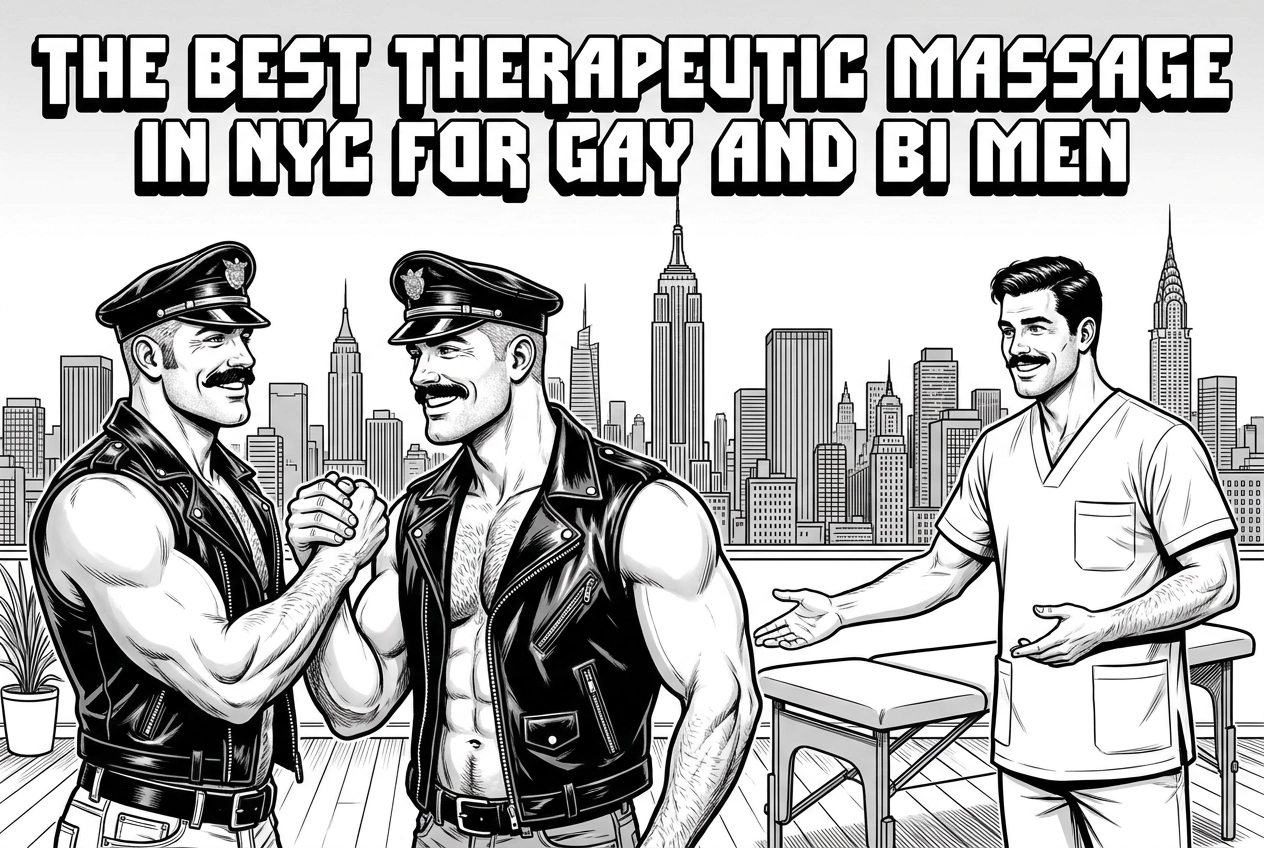
Finding the best therapeutic massage in NYC should feel straightforward, but for gay and bi men, the experience is about more than just skilled hands and quality technique. It is about finding a space where you feel genuinely comfortable, seen, and free to fully relax without any social tension or judgment getting in the way.
New York City offers an enormous range of massage options, but not all of them are created equal, and fewer still are truly welcoming to LGBTQ+ clients. Whether you are dealing with chronic muscle tension, stress from a demanding work schedule, or simply want to invest in your physical and mental well-being, you deserve a therapeutic experience that meets your needs on every level.
In this guide, we have done the research for you. You will discover a carefully selected list of the top massage providers in the city that combine genuine therapeutic expertise with an affirming, comfortable environment for gay and bi men. From licensed massage therapists to specialized wellness studios, here is everything you need to book your next session with confidence.
What Makes a Therapeutic Massage Actually Therapeutic
Not every massage qualifies as therapeutic, and in New York City, that distinction matters more than most people realize.
In clinical terms, a therapeutic massage involves three non-negotiable elements: a licensed massage therapist (LMT) operating under state credentialing, a documented modality with a defined physiological mechanism, and a measurable health outcome. Research published through the American Massage Therapy Association consistently links structured massage protocols to reduced cortisol levels, lower resting heart rate, decreased muscle tension, and improved range of motion. A generic relaxation rub delivered by an unlicensed provider in an informal setting produces none of these outcomes reliably, regardless of how pleasant it feels in the moment.
The Modalities That Actually Do Something
Each core modality targets a specific physiological problem. Swedish massage works through effleurage and petrissage strokes to regulate the nervous system and stimulate lymphatic circulation. Deep tissue addresses chronic tension and myofascial adhesions by reaching the deeper layers of muscle tissue that surface-level work cannot access. Hot stone therapy uses thermotherapy principles, where sustained heat dilates blood vessels and pre-softens resistant muscle groups before manual work begins. Thai massage applies rhythmic compression and assisted stretching to expand range of motion and mobilize connective tissue. Aromatherapy operates through the limbic system, where inhaled volatile compounds trigger neurochemical shifts that reduce perceived stress and modulate mood, making it a legitimate clinical adjunct rather than a luxury add-on.
Why Session Length Is a Clinical Variable
Session duration is not a preference; it is a structural constraint on outcomes. A 60-minute session, when properly structured, can address one focused area, such as the neck, shoulders, or lower back, with clinical precision. A 90 or 120-minute session allows full-body therapeutic work with time built in for a proper intake assessment and post-session aftercare guidance, both of which are markers of institutional rather than informal practice. Menquility structures all sessions across this 60-to-120-minute range precisely because different therapeutic goals require different time investments.
The Identity Variable No One Talks About
For gay and bisexual men, there is a fourth element that determines whether a session is genuinely therapeutic: the emotional safety of the room. The parasympathetic nervous system, which governs the relaxation response that makes massage physiologically effective, cannot activate fully when a client is bracing against perceived judgment or discomfort with their provider. Tension held in response to an affirming absence is the biological opposite of treatment. Research on LGBTQ+ health-seeking behavior consistently shows elevated rates of provider avoidance rooted in past experiences of being unseen or subtly corrected in clinical environments. A gay or bi man who cannot fully release in the room is not receiving therapeutic massage; he is enduring supervised tension.
The NYC Provider Gap
New York City has no shortage of massage providers. Platforms like MasseurFinder and Gay Wellness NYC list dozens of M4M practitioners across the five boroughs. What the city lacks is a meaningful supply of licensed M4M therapists operating inside institutionally structured, private-suite environments built specifically for gay and bi men. The majority of listings represent solo mobile practitioners or informal home settings, which, whatever their individual merit, cannot replicate the clinical consistency, privacy infrastructure, and affirming identity architecture of a dedicated facility. That gap is not a minor inconvenience; it is the central challenge for any gay or bi man in NYC trying to access massage that is therapeutic in every sense of the word.
Menquility: Best Overall for Gay, Bi, and Curious Men
Menquility occupies a category of its own in the New York City therapeutic massage landscape. Where most studios position LGBTQ inclusivity as a policy footnote, Menquility builds gay identity into the foundation of every element: the physical environment, the therapist model, the booking process, and the brand itself. The tagline "Gay hands. Queer care. Full stop." is not marketing language; it is an accurate description of how the studio operates. This is not a spa that welcomes gay men. It is a spa built by and for gay, bi, and curious men from the ground up.
Location and Access
Menquility — Kips Bay, Manhattan NYC. By appointment only. Contact the concierge for arrival details.
Full Modality Menu
The service menu spans Swedish, Deep Tissue, Hot Stone, Thai, and Aromatherapy alongside Gay Massage, Sensual Massage, and Nuru Massage, with sessions available in 60, 90, or 120-minute increments. That range gives clients the flexibility to target a specific physical concern, like chronic tension or muscle recovery, or simply decompress through a more sensory-focused experience, all within the same queer-affirming environment.
Discretion by Design
Private suites and the appointment-only model eliminate waiting rooms, communal check-ins, and chance encounters. For men who keep their wellness life separate from their public identity, this structure is not a luxury. It is a requirement.
Best for: Gay, bi, and curious men seeking licensed therapeutic work in a space built around their identity, particularly those who have felt uncomfortable or overlooked at generic spas.
Honest consideration: Same-day bookings are not available. Reserve in advance for evenings and weekends. Book via call or text at +1 (646) 347-1740 or email concierge@menquility.com.
Noble Men's Spa: Best for Luxury Presentation
Noble Men's Spa positions itself around a specific kind of exclusivity. Located at 274 Madison Ave in Midtown Manhattan, the studio describes its clientele as "discerning gentlemen" and explicitly confirms LGBTQ+ welcome on its FAQ page, listing gay, bi, straight, and curious men as part of its audience. The framing, however, is aesthetic-first rather than identity-first. This is a luxury presentation play, not a queer sanctuary. The distinction is worth understanding before you book.
The massage menu is structured and substantial. The flagship Signature Relief Deep Ritual blends Shiatsu, Tui Na, Thai stretching, sports massage, and myofascial release, running from $100 for 30 minutes to $460 for a 180-minute session. A Lomilomi Hawaiian Deep Release Ritual with hot coconut oil and hot stone is also available. Operationally, Noble Men's Spa holds a slight late-night edge, staying open until 11pm with last call at 9pm, making it a practical option for post-dinner bookings when most Midtown studios have already closed.
One practical note before you commit: a minimum 20% gratuity is expected, paid in cash, Venmo, or Zelle. Card tips are not accepted, and card payments carry additional fees. The listed price is not your all-in cost. Plan accordingly.
The brand draws aesthetic references from Giorgio Armani's 1982 Milan residence and frames massage as "performance art," positioning the therapist as artist and the client's body as the medium per the spa's About page. That is elevated language for a men's wellness space, and it delivers a polished, upscale environment. What it does not deliver is queer identity alignment. Gay and bi men will find a comfortable, professional setting with no judgment and genuine inclusivity in service delivery. They will not find a space built around their specific experience.
Best for: Men whose primary goal is a refined, luxury spa aesthetic in a LGBTQ-friendly (not LGBTQ-specific) environment, particularly for evening appointments after 9pm when most alternatives are unavailable.
Seasons Men's Spa: Best for East Village Proximity
Seasons Men's Spa occupies a distinct geographic niche in this roundup. Established in December 2024 at 243 E 13th St in the East Village, it is one of the newest entrants in the current wave of queer-inclusive men's wellness studios opening across NYC. The spa welcomes gay, bi, and curious men and operates exclusively by appointment, with sessions available daily from 10am to 11pm.
The most compelling differentiator here is the therapist roster. Seasons draws from an international, multicultural team with backgrounds spanning Turkey, Brazil, Korea, India, Thailand, Russia, Mexico, and beyond. For clients who have specific cultural or stylistic preferences in bodywork, that range is genuinely useful. Swedish, Deep Tissue, Thai Yoga Stretching, Shiatsu, and multi-therapist Four Hands sessions are all on the menu.
The geographic case for Seasons is straightforward. Most M4M spa options in NYC cluster in Midtown and the west side. Seasons sits closer to the Lower East Side, Alphabet City, and Nolita, making it the more practical choice for downtown residents who would otherwise travel uptown for an appointment.
The honest consideration is this: as a spa operating for less than two years, the brand track record is still forming. Early reviews on Apple Maps show a 90% positive score from initial ratings, but some early reviewers have flagged operational inconsistencies that are common in newer businesses still calibrating. The multicultural roster is a real draw, but the institutional consistency of a more established provider is not yet present. Worth monitoring as its reputation develops through 2026.
Best for: Downtown Manhattan residents and visitors seeking an M4M, appointment-based therapeutic session in the East Village or Lower East Side.
Independent M4M Practitioners: What to Know Before You Book
Platforms like MasseurFinder aggregate independent M4M practitioners across neighborhoods including Hell's Kitchen, Chelsea, Murray Hill, and the Upper West Side. Pricing across active NYC listings runs from roughly $100 on the low end to $200 and above for premium or extended sessions, with the majority clustering between $120 and $200 for a standard 60-minute appointment.
The Case for Going Independent
Solo practitioners offer genuine advantages. Many provide mobile services with flexible scheduling windows that stretch from early morning to late evening, seven days a week, which studio-based providers cannot always match. Some independents have cultivated strong repeat client relationships over years, with documented testimonials describing consistent therapeutic outcomes including tension relief, improved mobility, and stress reduction. Loyalty discounts and advance-booking perks are also more common among independent providers than institutional studios.
The Credibility Gap You Cannot Ignore
This is where scrutiny is essential. Licensing claims on independent platforms vary widely and are difficult to verify. Self-reported "LGBTQ+ friendly" or "gay-affirming" language appears frequently across profiles, but these are unverified assertions with no structural backing. There is a meaningful difference between a practitioner who describes himself as inclusive and a dedicated institutional space with trained staff, documented policies, and consistent intake protocols. Fixed-address consistency also varies; some practitioners list neighborhood-level locations rather than a confirmed studio address, and physical infrastructure like private suites or post-session care documentation is rarely described.
What to Verify Before You Commit
If you choose this route, screen for four specifics: a verifiable NYS massage therapy license number (cross-referenced through the NYS Office of the Professions), a fixed studio or reliable mobile address, clear service descriptions without vague or ambiguous language, and reviews that describe physical or therapeutic outcomes rather than atmosphere or appearance alone. Membership in organizations like the AMTA is a meaningful signal, as it requires active licensure and adherence to a professional code of ethics.
Independent practitioners work best for clients with a trusted referral, non-standard scheduling needs, or an established relationship with a specific therapist. They are not a recommended first-choice for men prioritizing verified therapeutic credibility, consistent discretion infrastructure, or the kind of structured gay-affirming environment that a dedicated M4M studio is built to provide.
Getting There: Midtown as NYC's Therapeutic Massage Hub
Menquility — Kips Bay, Manhattan NYC. By appointment only. Contact the concierge for arrival details.
The travel math from key neighborhoods is straightforward. Hell's Kitchen is roughly 10 minutes away via the A/C/E to 34th Street Penn Station. Chelsea clients can walk the 20-minute route along Seventh Avenue or take a single subway stop. Greenwich Village and the Financial District both clock in around 15 minutes via direct train. The Upper East and West Sides sit approximately 20 minutes out. For a city where crosstown trips can feel like expeditions, this kind of centrality is a genuine convenience.
Hell's Kitchen deserves specific mention. As one of Manhattan's densest concentrations of gay male residents and LGBTQ nightlife, it generates consistent demand for gay-affirming wellness options. The proximity to Menquility means an after-work or post-weekend booking is practical rather than an event requiring extra effort.
The 32nd Street Koreatown corridor adds one more layer of appeal. The block surrounding Menquility is dense with restaurants, cafes, and late-night hospitality, making it easy to extend a massage appointment into a full evening without backtracking across the city.
A Note for Bi and Curious Men: Discretion Is Not an Afterthought Here
For men who are bisexual, questioning, or anywhere outside a fixed identity label, the phrase "all are welcome" does not address the actual concern. The concern is structural: what happens when you walk in, who sees you, what record exists afterward, and whether the environment itself was designed with your experience in mind. Generic spas, however professionally run, were not built around this population. Menquility was.
The appointment-only model is the first layer of that infrastructure. Because there are no walk-ins at Menquility, there is no lobby exposure, no accidental overlap with another client, and no front-desk exchange in a shared public space. Your session is booked, confirmed, and contained before you arrive. The visit is pre-structured so that the moment you enter the building, you are moving through a private, predetermined sequence rather than navigating a social environment.
Private suites extend that logic into the physical architecture. There is no communal locker room, no shared relaxation area, and no ambient social pressure between sessions. Your appointment exists in its own contained space, fully separated from every other client's experience. That is not a premium upgrade; it is the baseline operating model.
The judgment-free framing at Menquility is organisational, not individual. The studio was built by and for gay and bi men, which means the environment itself carries no ambient guardedness for men exploring identity on any point of the spectrum.
Finally, booking by call, text to +1 (646) 347-1740, or email creates no public profile, no app-based history trail, and no third-party platform record. For a man who is not out in every context, that level of intake control is not a small detail; it is the deciding factor.
Therapeutic Massage for Post-Workout Recovery: An Underrated Use Case
The science supporting massage as a recovery tool is no longer fringe. A 2025 randomised controlled trial of 150 athletes found that bi-weekly deep tissue massage sessions produced measurable gains in muscle recovery, strength, and flexibility, with the strongest outcomes seen in strength and team sport athletes. Longer sessions specifically correlated with superior flexibility improvements, a finding directly relevant to anyone managing the cumulative load of a structured training week. A 2024 systematic review drawing on 31 studies confirmed that massage demonstrated a large and substantial advantage over inactive control conditions across DOMS reduction, circulation improvement, and psychological recovery outcomes. Both Swedish and Deep Tissue modalities earn their place here: Swedish massage targets inflammation and perceived soreness at the surface level, while Deep Tissue addresses the deeper muscle groups most taxed by compound lifts, particularly in the lumbar region, knees, and shoulders.
What the Manhattan post-workout massage landscape has not done is speak to gay men specifically. Chelsea, Hell's Kitchen, and increasingly Midtown represent one of the densest concentrations of serious gay male fitness culture in the country. Gym culture is central to how many men in these neighborhoods structure their weeks, their social lives, and their sense of physical self. Yet no NYC provider has connected that identity directly to therapeutic recovery work.
Men's Touch Therapy in Chelsea, operated by an independent practitioner named Kristofer at $150 per session, is the only solo therapist explicitly leading with a sports recovery angle. It is worth noting for Chelsea-based clients with a specific sports focus, though it operates without private suites or institutional infrastructure.
A 90-minute Deep Tissue session at Menquility addresses both dimensions of recovery: the physical tissue work and the mental decompression that high-performance training consistently demands. The research supports it. The demand is real. The gap in provider positioning remains wide open.
How to Choose the Right Therapeutic Massage in NYC
The decision comes down to one question: what do you actually need from this session? Match your primary need to the provider built for it. If your priority is luxury amenities and hotel-grade presentation, a high-end day spa fits. If you need a budget-friendly option close to home, a neighborhood bodywork studio works. If sports recovery is the driving factor, seek a practitioner whose clinical focus is specifically rehabilitative.
For gay, bi, and curious men whose criteria include both licensed therapeutic outcomes and an identity-affirming environment, the calculus is simpler. Menquility is the only institutional option in NYC currently structured to deliver both without compromise. No directory listing, no generic "inclusive" policy footnote, and no shared amenity floor achieves what a purpose-built queer sanctuary does: the felt sense of safety that allows the nervous system to actually release.
That physiological detail is not incidental. It is the treatment.
Menquility — Kips Bay, Manhattan NYC. By appointment only. Contact the concierge for arrival details.
Conclusion
Finding the right therapeutic massage in NYC comes down to three things: skilled technique, genuine expertise, and an environment where you feel completely at ease. As a gay or bi man, you deserve all three without compromise. The providers highlighted in this guide combine licensed therapeutic knowledge with truly affirming spaces, so your physical recovery and mental relaxation are never secondary to social comfort.
Your well-being is worth investing in. Whether you are managing chronic tension, recovering from physical strain, or simply prioritizing self-care, the right massage therapist can make a meaningful difference in your daily life.
Do not settle for a space that makes you feel like an afterthought. Use this guide to book your first session today, and take a real step toward feeling better in your body, your mind, and your life.