Journal / June 23, 2026
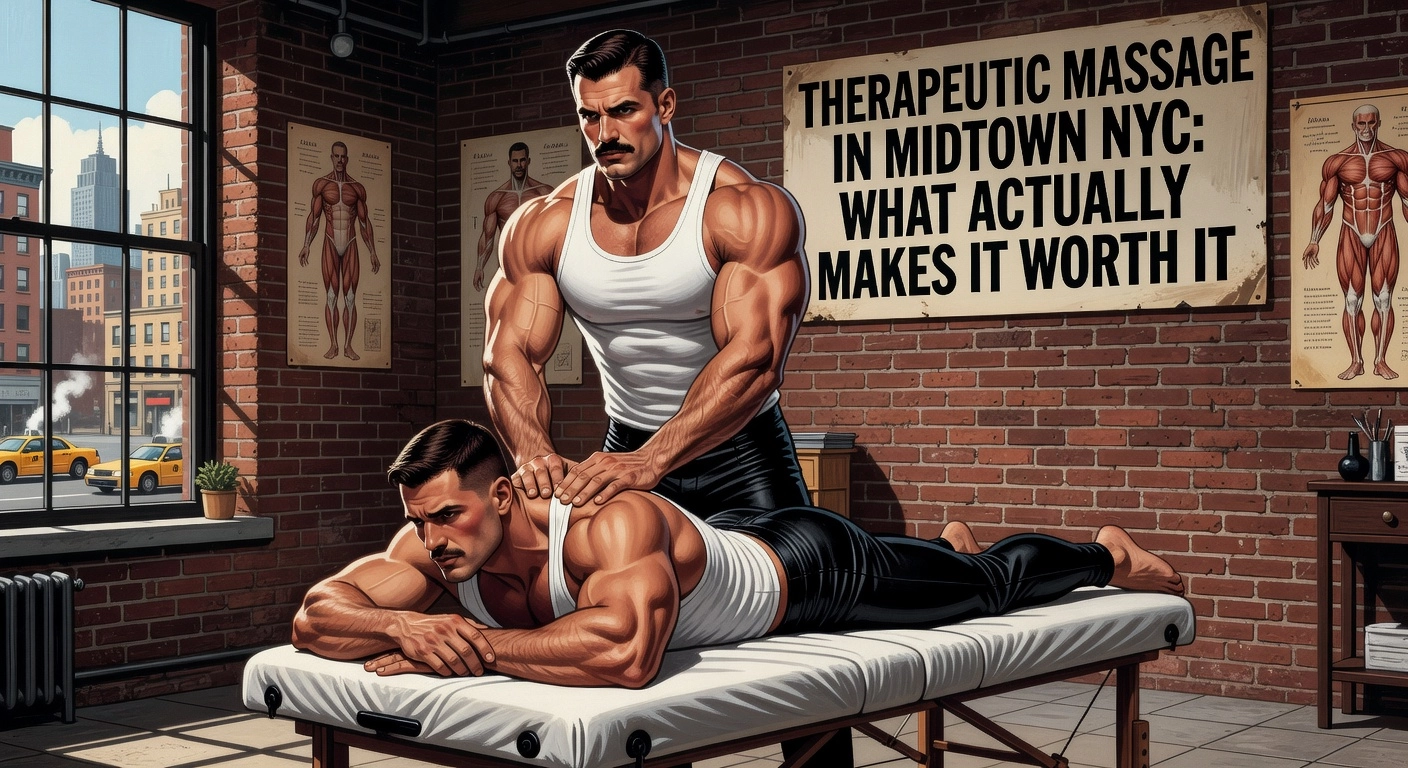
Therapeutic Massage in Midtown NYC: What Actually Makes It Worth It
Discover what sets therapeutic massage in Midtown NYC apart, from modalities to discretion. A guide built for gay, bi, and curious men ready to book.
By Menquility Team
You've had a long week. Your shoulders are tense, your neck is stiff, and you keep hearing people talk about how much better they feel after getting a massage. But with so many options in the city, how do you know if it's actually worth your time and money?
If you've been curious about therapeutic massage in Midtown NYC but aren't sure where to start, you're in the right place. This isn't just about relaxation (although that's definitely a perk). Therapeutic massage offers real, tangible benefits that go beyond a simple spa day, and Midtown happens to be one of the best places in the city to find quality care.
Whether you're a total newcomer or someone who has only ever gotten the occasional chair massage at a work event, this guide breaks down exactly what makes therapeutic massage worth it. From the types of massage available to what you should expect during your first session, we're covering everything you need to know to make a confident, informed decision. Let's get into it.
What Therapeutic Massage Actually Means (And Why the Provider Matters)
Let's get one thing straight (no pun intended): therapeutic massage is not just a fancy word for relaxation. Therapeutic massage is licensed, outcome-driven bodywork performed by trained professionals who are targeting specific physical and mental health goals. We're talking about addressing chronic pain, muscle recovery, stress-related tension, postural issues, and even mental health support through evidence-informed techniques like deep tissue work, myofascial release, and trigger point therapy. It's assessment-based, results-oriented, and a world away from a generic spa rubdown.
The numbers back this up. According to AMTA 2026 data, 23% of US men received a massage in the past year, surpassing women at 19%. Their top reasons? Soreness and stiffness (49%), stress reduction (43%), chronic pain (42%), injury recovery (36%), and mental health (26%). Men are increasingly treating massage as healthcare, not a luxury indulgence.
Here's where it gets important: who delivers your massage shapes absolutely everything. A well-matched therapist builds trust through open communication, cultural sensitivity, and genuine attunement to your needs. A mismatched provider, even a technically skilled one, can leave you guarded, unable to fully relax or speak up about pressure and discomfort. That guardedness directly limits your results.
This is why the difference between a truly affirming environment and a clinically neutral one matters so much. Generic chain settings prioritize volume and standardization. Clinical spaces offer professional detachment. But a gay-affirming therapeutic environment, like the private suites at Menquility in Midtown Manhattan, actively signals inclusion for gay, bi, and curious men without heteronormative assumptions or judgment.
A truly therapeutic session requires trust. And trust requires feeling seen.
A Plain-Spoken Breakdown of Every Modality on the Menu
Menquility — Kips Bay, Manhattan NYC. By appointment only. Contact the concierge for arrival details.
Swedish Massage is the classic starting point, and for good reason. Long, flowing strokes, gentle kneading, and steady pressure work together to ease muscle tension and improve circulation from head to toe. If you've never had a professional massage before, or if stress has your whole body wound tight, Swedish is the ideal entry point. It's not "light" in the sense of being ineffective; it's simply built around full-body relaxation rather than targeting one specific problem area.
Deep Tissue Massage goes further. It uses slower, firmer pressure to reach the deeper layers of muscle where chronic tension, adhesions, and stubborn knots tend to live. If you train regularly, spend long hours at a desk, or carry physical stress in your neck, shoulders, or lower back, deep tissue is often the modality that actually solves the problem rather than just masking it.
Hot Stone Massage adds heated basalt stones to the equation. The warmth penetrates muscle tissue in a way that hands alone can't replicate, creating a grounded, almost meditative quality to the session. It's a genuinely different experience from standard pressure work, especially useful when your body needs to release without enduring intense manual pressure.
Thai Massage is performed fully clothed and involves assisted stretching, acupressure, and rhythmic compression along energy lines. It's excellent for improving flexibility, joint mobility, and range of motion, particularly if you feel stiff or restricted in your movement.
Aromatherapy isn't a standalone modality so much as a sensory layer added to any session. Essential oils like lavender or eucalyptus engage the limbic system, helping to reduce anxiety, improve mood, and support recovery.
Nuru and Sensual Massage are body-to-body modalities delivered by gay-affirming M4M therapists in a completely private setting. These are valid, judgment-free options for stress release and physical connection, explained without stigma and offered alongside every other service on the menu.
All of the above are available in 60 to 120 minute sessions; check Menquility's pricing and book by appointment only.
Why Appointment-Only and Private Suites Change Everything
Think about the last time you walked into a busy wellness chain. You checked in at a front desk, sat in a shared waiting area with strangers, maybe overheard someone else's conversation through a thin wall. For plenty of men, that experience alone is enough to never book again.
Walk-in focused studios are built around volume. More clients through the door means more revenue, but it also means less time for therapist preparation, less room for personalization, and sessions that can feel rushed or generic. Appointment-only models flip that entirely. When a therapist knows you are coming, they can review your intake notes, understand your focus areas, and arrive ready to deliver something intentional. According to 2026 massage therapy market analysis, the industry is trending hard toward personalized, outcomes-driven experiences precisely because clients are tired of transactional bodywork.
Private suites remove another major barrier: social exposure. Shared waiting rooms, communal locker areas, and open floor plans create a low-grade visibility that makes many men uncomfortable before the session even starts. A private suite means you walk in, close the door, and the outside world disappears.
For gay, bi, and curious men specifically, this matters even more. Generic wellness settings carry ambient judgment that is often invisible but very real. A dedicated, affirming space removes that entirely. You are not wondering how the therapist feels about you. You already know the answer.
That consistency is also what separates a branded, appointment-only studio from the fragmented independent M4M market. Independent providers vary wildly in licensing, environment quality, and professionalism. A dedicated studio signals something different: you are a client worth preparing for, not just the next name on a list.
The Discretion Factor: What It Means to Book With People Who Get It
Discretion is not the same thing as secrecy. Secrecy implies hiding something shameful. Discretion is something entirely different; it is the intentional design of an experience where you never have to explain yourself, justify your presence, or decode someone else's assumptions about why you are there. That distinction matters more than it might sound.
Gay-affirming therapists bring something to the table that no amount of "we welcome everyone" signage can replicate. They already understand the unspoken communication, the body language, the way boundaries get navigated between men, without requiring you to educate them mid-session. Research from CUNY's School of Public Health highlights that gay and bi men face real emotional drain just from searching for suitable care providers. An affirming space removes that friction entirely before you even walk in the door.
Here is something worth acknowledging openly: a lot of gay, bi, and curious men search for "therapeutic massage Midtown NYC" rather than more specific terms, because explicit language can feel exposing in a browser history, a review platform, or a booking confirmation email. Affirming studios understand this and meet clients exactly where they are searching, without requiring anyone to out themselves just to book an appointment. The Trevor Project's 2025 survey found that identity disclosure remains a real concern across LGBTQ+ care contexts, and wellness is no exception.
Booking at Menquility starts with a phone call, a text, or an email to concierge@menquility.com, not a public queue or a shared front desk. That single detail adds a meaningful layer of privacy from the very first point of contact. The entire model, licensed M4M therapists working in private suites, strictly by appointment, inside a queer-owned space built for gay, bi, and curious men, was designed specifically around this understanding. It is not an afterthought. It is the whole point.
Licensed Studio vs. Independent Therapist: How to Tell the Difference
Not all massage providers are created equal, and when you are shopping around for therapeutic massage in Midtown NYC, understanding the difference between a licensed studio and an independent listing could genuinely affect your safety, your experience, and your peace of mind.
Here is the baseline you need to know: licensed massage therapists in New York State must complete a minimum of 1,000 hours of accredited training before they can legally practice. That training covers anatomy, physiology, pathology, hands-on supervised practice, and more. They also have to pass a New York State board examination and meet ongoing requirements to keep that license active. New York's 1,000-hour threshold is actually one of the highest in the country, so this is not a low bar.
The tricky part is that independent M4M providers listed on directories may or may not hold active licenses, and there is genuinely no easy way for a client to verify that without asking directly. Many directory listings do not confirm credentials at all.
A branded studio solves that problem by design. Licensed therapists, business registration, structured intake forms, and clear accountability are all built into how the operation runs. If something goes wrong, there is a real process for addressing it.
Before booking anywhere, ask three simple questions: Is the therapist currently licensed in New York State? Is the studio operating under a business license? Is there a formal intake and consent process before the session starts?
Menquility is built on exactly this kind of licensed therapeutic credibility, combined with explicit queer affirmation for gay, bi, and curious men. That specific combination, clinical legitimacy plus unapologetic M4M identity inside a single branded studio, is genuinely rare in Midtown Manhattan.
Getting Here From Chelsea, Hell's Kitchen, Greenwich Village, and Beyond
Menquility — Kips Bay, Manhattan NYC. By appointment only. Contact the concierge for arrival details.
From Chelsea, count on roughly 15 minutes by subway or about 20 minutes if you prefer to walk north along 6th or 7th Avenue. No transfers needed, which makes it one of the more effortless trips in the city.
From Hell's Kitchen, you are looking at about 10 minutes. It is genuinely one of the closest gay-identified neighborhoods to the studio, which makes spontaneous appointment bookings very realistic.
From Greenwich Village or the West Village, the A, C, E lines or the 1 train get you there in around 20 minutes with direct access and minimal hassle.
From the Financial District, Upper East Side, or Upper West Side, expect 25 to 30 minutes via direct routes or a single transfer. Midtown's central position keeps the math simple from nearly every direction.
If you are visiting NYC and staying near Times Square, Penn Station, or Herald Square, the studio may actually be walkable from your hotel. That makes Menquility a genuinely convenient option for out-of-town clients who want a private, affirming therapeutic massage experience without navigating unfamiliar transit.
Why More Men Are Booking Therapeutic Massage in 2026
Something big is happening in men's wellness right now, and the numbers back it up. The US massage therapy market is projected to hit $22.62 billion in 2026, growing at roughly 7.69% annually through 2032. That is not a niche trend. That is a cultural shift playing out in real time.
What makes it even more interesting is that men are leading the charge. The men's segment is growing at approximately 8% CAGR through 2030, outpacing the broader market. Stigma around men getting massages is fading fast, and honestly, it is about time.
So what are men actually booking massage for? AMTA 2026 data breaks it down clearly. Muscle soreness and stiffness top the list at 49%, followed by relaxation and stress reduction at 43%, chronic pain management at 42%, injury recovery at 36%, and mental health reasons at 26%. These are not luxury motivations. They are legitimate physical and emotional needs.
The other big shift in 2026 is personalization. Clients are moving away from generic one-size-fits-all sessions and toward outcome-driven bodywork that actually addresses their specific goals, whether that is recovering from a tough week, managing tension, or simply disconnecting.
For gay and queer men, this moment carries extra weight. Men's wellness is finally normalized, and affirming spaces built specifically for queer clients are emerging to meet that demand head-on. That convergence means you no longer have to choose between effective therapeutic care and an environment where you actually feel comfortable. You get both.
How to Book Your First Session at Menquility
Ready to book? Here is exactly how it works, start to finish.
Step 1: Choose your modality based on your goal. If you are dealing with work stress or general tension, Swedish or aromatherapy are solid starting points. If you have tight muscles from the gym or a nagging knot in your shoulders, deep tissue or hot stone will serve you better. If you are curious about something more sensual and therapeutic, options like sensual massage or Nuru are available in the same affirming, private environment. Not sure? The team can help you figure it out when you reach out.
Step 2: Pick your session length. Sixty minutes is great for targeting one specific area or just getting a feel for the experience. If you want a head-to-toe reset, go with 90 or 120 minutes. Longer sessions are especially worth it if muscle recovery or full-body decompression is the goal.
Step 3: Make contact. Call or text Menquility at +1 (646) 347-1740 or email concierge@menquility.com. There are no walk-ins; every session is by appointment, which protects your privacy from the moment you book.
Step 4: Complete a brief intake. Before you arrive, you will share your goals, pressure preferences, and any areas of focus so your therapist is prepared and the session is tailored specifically to you.
Menquility — Kips Bay, Manhattan NYC. By appointment only. Contact the concierge for arrival details.
First-timers are genuinely welcome here. No prior massage experience, no identity disclosure, and no explanation required.
The Bottom Line on Therapeutic Massage in Midtown NYC
Midtown NYC has no shortage of massage options, but most of them were not built with you in mind. Clinical chains prioritize volume. Independent providers vary wildly in licensing and professionalism. And most general spas treat gay, bi, and curious men as an afterthought, if they consider them at all. The right therapeutic massage experience should feel affirming from the very first text you send, through the booking confirmation, the moment you walk in, and the hands working on your body.
Menquility was built specifically to fill that gap. It is queer-owned, fully licensed, appointment-only, and designed from the ground up for gay, bi, and curious men. You are not an edge case here; you are the intended client.
Menquility — Kips Bay, Manhattan NYC. By appointment only. Contact the concierge for arrival details.
Conclusion
Therapeutic massage in Midtown NYC is more than a luxury; it's a practical investment in your physical and mental well-being. You now know that the right massage targets real tension, supports recovery, and delivers benefits that last well beyond the session itself. You also know that Midtown offers access to skilled therapists who can personalize treatment to your specific needs, whether you're managing chronic stress, recovering from an injury, or simply overdue for some genuine self-care.
The hardest part is often just making the first appointment. Once you do, most people wonder why they waited so long. Don't let another stressful week pass without taking action.
Book your first therapeutic massage session today and find out firsthand what your body has been missing. You've earned it, and your future self will thank you.