Journal / July 23, 2026
Manhattan Massage Spas: What to Know Before You Book
Not every Manhattan massage spa is built for you. Here's how to find one that actually is, including a queer-affirming M4M studio in Midtown.
By Menquility Team
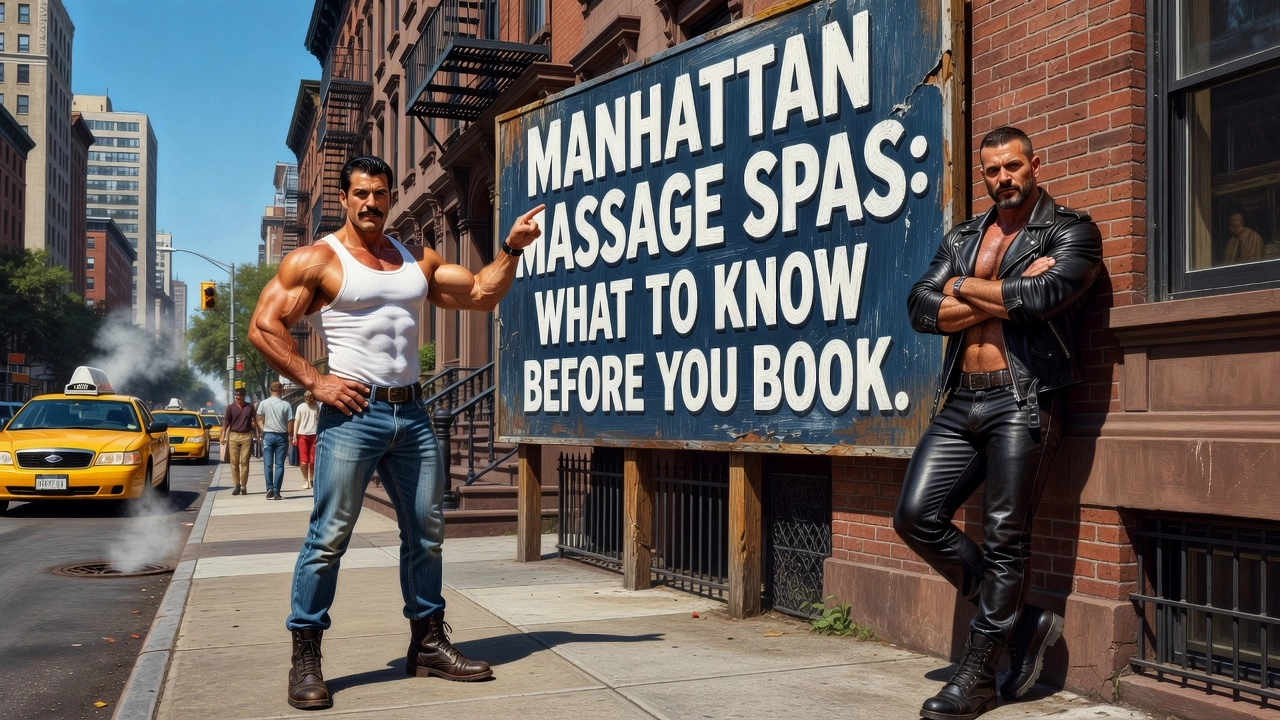
So you've decided to treat yourself to a massage in the city that never sleeps. Great choice! But if you've ever tried searching for a Manhattan massage spa, you already know the struggle. There are hundreds of options, and figuring out where to start can feel just as stressful as the tension you're trying to melt away.
Whether you're a first-timer who has never set foot in a spa or someone who simply wants to explore what New York City has to offer, this guide is for you. Booking a massage in Manhattan doesn't have to be overwhelming, and with the right information, you can walk in feeling confident instead of confused.
In this post, we're breaking down everything a beginner needs to know before hitting that "book now" button. From understanding different massage types to knowing what questions to ask and what red flags to avoid, we've got you covered. By the end, you'll be ready to find the perfect spot and finally give yourself the relaxation you deserve.
What Makes a Manhattan Massage Spa Worth Booking
Not every manhattan massage spa is worth your time or your trust. Here are five things that actually separate a quality booking from a regrettable one.
1. Licensing and Credentials Are Non-Negotiable
In New York, massage therapists must be licensed through the NYS Office of the Professions, which requires completed training hours and passing the MBLEx licensing exam. Nationally, 48 states require licensure, and 47 of those mandate 500 or more hours of education before a therapist can legally work on clients. In Manhattan's fragmented M4M market, where independent operators and solo listings exist alongside legitimate studios, this distinction matters more than people realize. A credible spa should be transparent about who is working on you and what credentials they hold. If that information is nowhere on the site, that tells you something.
2. Appointment-Only Is a Privacy Signal, Not a Scheduling Quirk
Walk-in spas prioritize volume. Appointment-only studios prioritize you. According to spa industry research, booking format is now an industry-level variable that reflects how a business is structurally designed. When a spa runs by appointment only, it eliminates client overlap, controls the environment, and communicates that discretion is built into the model, not added as an afterthought.
3. Gay-Affirming Is Different From Merely Tolerant
A spa that is designed for your identity delivers a fundamentally different experience than one that is simply not unwelcoming. Research shows that 78% of massage bookings come from repeat clients, which means emotional safety is not a soft value; it drives real behavior. Feeling genuinely seen changes how deeply you can relax.
4. Service Range Reflects Therapeutic Intent
A menu that includes Swedish, Deep Tissue, Hot Stone, Thai, and session lengths from 60 to 120 minutes signals that the studio was built for actual therapeutic outcomes. Shallow menus with one or two options usually mean the focus is turnover, not care.
5. Location Should Remove Friction, Not Create It
Easy subway access from Midtown, Chelsea, Hell's Kitchen, or the Financial District means you can get there quickly and without unnecessary stress, which is kind of the whole point.
The Types of Massage Spas in Manhattan (And Who Each One Is For)
Manhattan has a surprisingly wide range of massage options, and they are definitely not all built the same. Knowing what each type offers (and who it actually serves best) saves you time, money, and a whole lot of awkward situations.
1. Hotel and Luxury Day Spas
These are the big, polished names you see featured in travel guides. Think candlelit treatment rooms, robes, cucumber water, and price tags to match. Places like Oasis Day Spa in Midtown serve a broad mix of hotel guests, tourists, couples, and corporate clients looking for a premium experience. The ambiance is genuinely impressive, and the therapists are typically well-trained. The catch? These spaces are designed for everyone, which means they are not designed for anyone in particular. If you are a gay or bi man hoping to feel fully seen and comfortable, a generic luxury spa is unlikely to offer that. You will be well-massaged, but the environment is neutral at best.
2. Korean Spas and Bathhouse Formats
Korean spas bring a completely different energy. They are communal, rooted in cultural tradition, and usually very affordable compared to luxury day spas. The experience typically involves shared soaking pools, body scrubs, and steam rooms. Gender separation is standard, and the social format means privacy is limited. There is real value in this format for people who love the ritual and the community aspect of it. However, if you are looking for a one-on-one therapeutic session in a private suite with a therapist who understands your specific needs and comfort level, the Korean spa format is not really built for that.
3. Solo Independent Therapist Directories
Platforms like MasseurFinder connect clients with individual therapists working independently across Manhattan. Pricing in this category ranges widely, from around $80 up to $230 or more per session, depending on the therapist's experience and specialty. The flexibility can be appealing, but the inconsistency is a real issue. Licensing standards vary, there is no studio infrastructure backing the booking, and discretion practices are entirely up to the individual. For queer clients especially, the experience can feel like a gamble, since there is no brand accountability or vetted affirmation standard behind the listing.
4. General Men's Spas
Some Manhattan spas do focus specifically on male clients, offering massage alongside grooming services like waxing and skincare. These spaces are more price-competitive and often more casual in feel. They serve a broad male clientele well. However, being male-focused is not the same as being queer-affirming. The design, the language, and the therapist culture in general men's spas tend to be inclusive in a passive sense, meaning they will not turn you away, but they are not actively built around your identity either.
5. Queer-Affirming M4M Therapeutic Studios
This is the newest and most intentional category in the Manhattan massage spa landscape. Studios like Menquility are purpose-built for gay, bi, and curious men, with appointment-only private-suite models, licensed M4M therapists, and a brand identity that signals active affirmation rather than passive tolerance. The entire experience, from how you book to how the space feels when you walk in, is designed with your comfort and privacy as the foundation. This is not a wellness afterthought. It is the whole point.
What a Queer-Affirming Manhattan Massage Spa Actually Looks Like
If you have ever wondered what separates a truly queer-affirming manhattan massage spa from one that just tolerates you, the difference shows up in every detail before your session even begins.
Appointment-Only Means More Than Just Scheduling
When a spa operates by appointment only with zero walk-ins, the practical payoff for queer and bi clients goes well beyond convenience. There is no lobby where you sit next to a stranger, no chance of bumping into a coworker at the front desk, and no receptionist making small talk that puts you in an awkward spot. Menquility is built around this model deliberately: your arrival window is yours, the schedule is staggered, and the entire session is designed around your timeline. That structure alone removes a layer of social anxiety that most people do not even name out loud until it is gone.
What "Private Suite" Actually Means in Physical Terms
First-timers sometimes assume a private suite is just a curtained partition in a shared room. It is not. A curtained-off table in an open room still exposes you to ambient noise from adjacent tables, nearby conversations filtering through thin fabric, and sightlines at the entry and exit points. A private suite is a self-contained, lockable room; your therapist enters and exits through one door, and everything that happens inside stays inside. For gay, bi, and curious men who are weighing whether to book their first M4M session, this spatial difference is not a luxury upgrade. It is a safety baseline.
Gay-Affirming Is Not the Same as Gay-Friendly
A gay-friendly space does not discriminate. A gay-affirming space is built specifically for you. The distinction lives in therapist selection, brand language, and the physical environment. When a studio leads with "Gay hands. Queer care. Full stop." and staffs exclusively with M4M therapists, that is active design, not passive tolerance. LGBTQ travelers often note the difference between venues that welcome queer guests as an afterthought versus spaces where queer identity is the entire foundation.
Is This Legitimate? Here Is How to Read the Signals
Menquility — Kips Bay, Manhattan NYC. By appointment only. Contact the concierge for arrival details.
Therapeutic and Sensual Services Can Coexist
A queer-affirming studio that offers both Swedish deep tissue and sensual massage on the same menu is not contradicting itself. The therapeutic modalities treat muscle tension, circulation, and stress. The sensual options address intimacy, body comfort, and the specific needs of queer clients who want a judgment-free physical experience. Both exist within a professional, licensed framework, delivered by therapists who are trained and vetted for this exact context. The coexistence of these services is not a red flag; it is a sign that the studio respects the full range of what queer men actually need from a wellness space.
Menquility: Midtown Manhattan's M4M Therapeutic Studio
If you are ready to stop searching and actually book something worth your time, Menquility is the studio built for exactly that. Established in 2025, Menquility is a queer-owned, gay-affirming therapeutic massage studio in Midtown Manhattan, designed specifically as a private masculine sanctuary for gay, bi, and curious men. The brand does not hedge its identity or soften its language. The tagline says it plainly: "Gay hands. Queer care. Full stop." From the moment you land on their site to the moment you walk into your private suite, every detail communicates that this space was built by men, for men, without apology.
The Service Menu
The service menu is one of the most complete you will find in the M4M space. On the therapeutic side, Menquility offers Swedish, Deep Tissue, Hot Stone, Thai, and Aromatherapy massage, all delivered by licensed M4M therapists. Deep Tissue is worth highlighting specifically because it is not just a Menquility specialty; it accounts for 44.5% of the global massage therapy market by service type in 2026, making it the dominant modality worldwide. When a studio anchors its therapeutic core around Deep Tissue, that is a signal they are meeting real demand. Alongside the licensed modalities, Menquility also offers Gay Massage, Sensual Massage, and Nuru Massage for clients looking for something beyond the clinical. Sessions run from 60 to 120 minutes depending on the modality you choose, giving you real flexibility around your schedule and budget.
How Booking Works
Every session at Menquility is by appointment only, daily from 10am to 10pm. There are no walk-ins, and that is deliberate. The appointment-only format is a trust signal, not a barrier. It means your session is prepared, your suite is private, and your therapist is ready specifically for you. Booking is simple: call or text +1 (646) 347-1740, or email concierge@menquility.com.
If you are newer to M4M massage and want to orient yourself before booking, the Gay Massage in NYC: The Complete Guide for 2026 is a solid starting point covering what to expect, how to choose, and what sets quality studios apart.
Getting to Menquility from Anywhere in Manhattan
One of the best things about Menquility is how easy it is to reach from virtually any corner of Manhattan. Whether you are coming from a queer neighborhood or just finishing a long workday somewhere across the borough, the subway does most of the heavy lifting for you.
Chelsea and Hell's Kitchen
These two neighborhoods are arguably the most prominent queer communities in Manhattan, and both sit within easy striking distance. From Chelsea, the 1 train gets you to 34th Street in roughly five minutes. From Hell's Kitchen, the A/C/E drops you at 34th Street-Penn Station with just a short walk to finish the trip. Either way, you are looking at well under 15 minutes door to door.
Greenwich Village and the West Village
The 1 train runs straight up to 34th Street from the Village, making this one of the simplest rides in the city. No transfers, no confusion, just a familiar Midtown commute with a genuinely rewarding destination waiting at the end.
Upper East Side and Upper West Side
From the Upper West Side, the 2/3 express or the B/D puts you at 34th Street in around six to eight minutes. From the Upper East Side, the 6 train covers the distance efficiently with no transfers needed. Both rides are short enough to feel more like a warm-up than a commute.
Financial District and Lower Manhattan
The 2/3 express from Lower Manhattan to 34th Street-Penn Station is one of the faster rides on the subway grid. A midday break or an after-work session becomes completely realistic when the total travel time clocks in around 15 minutes.
Already in Koreatown?
Menquility sits directly within the 32nd Street Koreatown corridor, one of Midtown's most transit-dense blocks. The B/D/F/M at 34th Street-Herald Square and the 1/2/3 at 34th Street-Penn Station are both within easy walking distance. If you are already nearby, you are practically at the door.
Why the Manhattan Massage Market Is Growing (And What It Means for You)
Massage therapy is not a niche hobby anymore. It is a mainstream wellness category with serious economic momentum behind it, and Manhattan sits right at the center of that growth.
The global massage therapy services market is valued at approximately USD 76.6 billion in 2026 and is projected to hit USD 133.3 billion by 2036, growing at a steady 5.7% CAGR. That is not a trend. That is a structural shift in how people prioritize physical and mental recovery. Consumers are spending real money on therapeutic touch, and that investment is only accelerating. According to global spa market research, the broader spa industry is projected to grow from USD 182.6 billion in 2026 to USD 332.8 billion by 2035, with health benefits and mental wellness driving demand at every level.
The United States is the second fastest-growing massage market in the world, clocking in at a 7.5% CAGR, trailing only China at 8.3%. That pace is reshaping client expectations. People are no longer satisfied with a generic hour on a table. They want environments designed for them, therapists who understand their needs, and experiences that feel intentional from start to finish.
Within that expanding market, the M4M wellness niche has emerged as a recognized category between 2024 and 2026. Multiple NYC operators have started building queer-affirming identities as genuine brand pillars rather than footnotes in an FAQ. The spa services market forecast also confirms that personalization and specialized positioning are among the fastest-growing drivers of boutique spa growth. Appointment-only, private-suite formats have become the clearest trust signal in this space, telling clients before they even arrive that discretion is not an afterthought.
For gay, bi, and curious men in Manhattan, this growth means more options exist today than ever before. It also means more noise to sort through. More listings, more vague language, more spaces that are technically inclusive but were not actually built with you in mind. Knowing what the market looks like helps you ask better questions and book with more confidence.
How to Book Your Session at Menquility
Booking your first session is genuinely simple, and the process is designed to feel as low-pressure as the massage itself.
Menquility is appointment-only, open daily from 10am to 10pm, with no walk-ins accepted. That is not a limitation; it is the whole point. Because every visit is scheduled in advance, your therapist is prepared specifically for you, your private suite is ready when you arrive, and there is no lobby full of strangers to navigate. You get the full experience from the very first moment you walk through the door.
When you are ready to reach out, you have two options. You can call or text +1 (646) 347-1740, or you can email concierge@menquility.com. Both channels are handled with complete discretion. The concierge email address is not accidental; it signals that your inquiry is treated with the same care as the session itself. You can also explore availability and services directly through the Menquility About page before reaching out.
When you make contact, you will choose a session length of 60 or 120 minutes and select from the full service menu, including Swedish, Deep Tissue, Hot Stone, Gay Massage, and more. The team will confirm your private suite and walk you through anything you need to know.
If this is your first time booking a gay massage in NYC, no prior spa knowledge is required. You do not need to know what M4M means, have a rehearsed script ready, or feel certain about your identity. Gay, bi, curious, or simply open, you are welcome here without explanation or judgment.
Finding the Right Manhattan Massage Spa Starts with Knowing What You Need
By this point, you have the full picture. The five criteria that actually matter when evaluating a manhattan massage spa are licensing, privacy format, therapist affirmation, service range, and location accessibility. Run any option through those five filters and the right choice becomes obvious pretty quickly.
Manhattan genuinely offers every category of spa experience you could want. But there is a meaningful difference between a spa that is open to queer clients and one that was built for them from the ground up. Queer-affirming M4M studios are not a happy accident. They are an intentional design decision, and that intention shows up in every part of the experience.
Menquility — Kips Bay, Manhattan NYC. By appointment only. Contact the concierge for arrival details.
Text or call +1 (646) 347-1740 or email concierge@menquility.com to book your session today.
Conclusion
Booking a massage in Manhattan does not have to feel like a second job. By understanding the different massage types available, knowing the right questions to ask before you book, spotting red flags early, and choosing a spa that matches your specific needs, you can walk in with confidence and walk out completely renewed.
New York City has no shortage of incredible wellness options. The key is simply knowing what to look for before you commit.
Now it is your turn to take action. Browse a few local spas, compare their menus and reviews, and do not hesitate to call ahead with questions. You deserve a experience that is relaxing from start to finish, not just the hour on the table.
Your perfect Manhattan massage is out there. Go book it, and give yourself the reset you have earned.