Journal / June 5, 2026
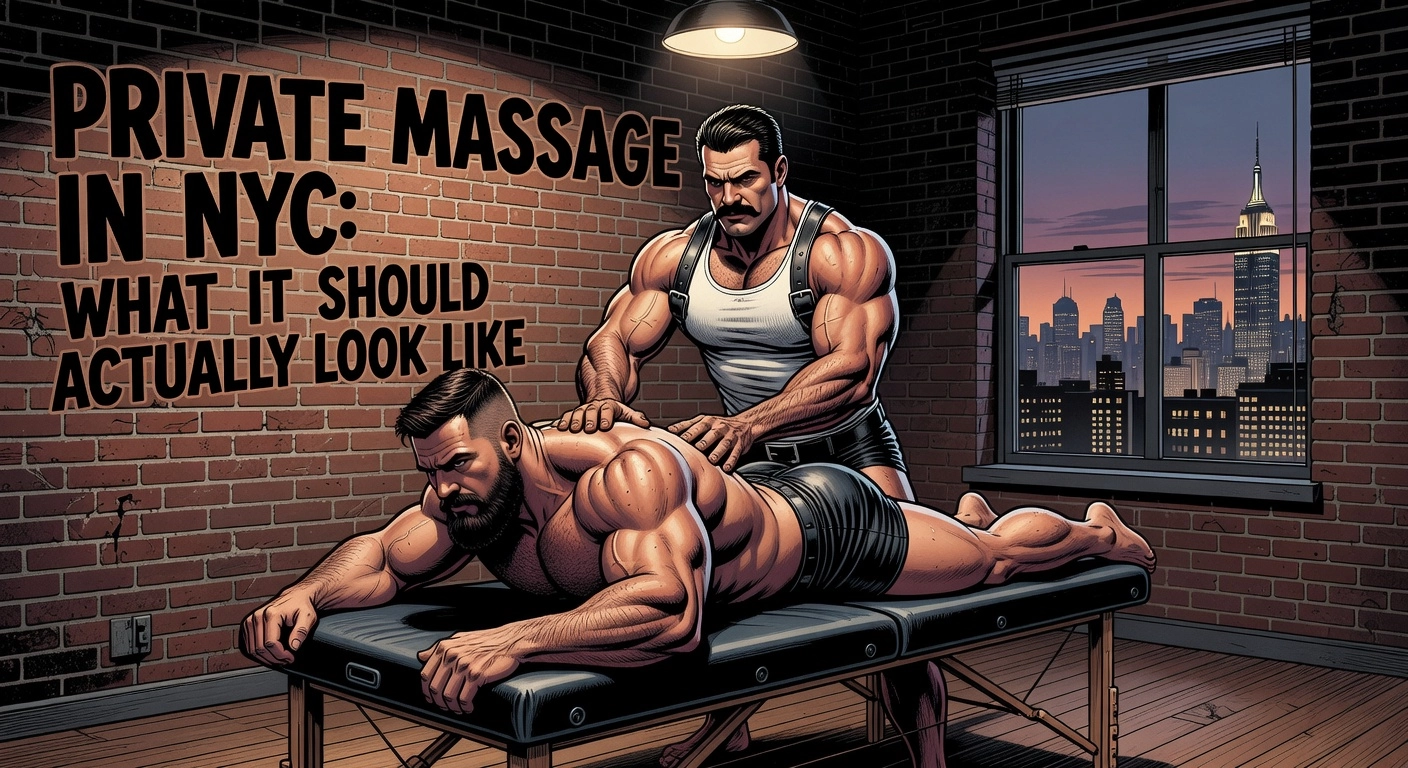
Private Massage in NYC: What It Should Actually Look Like
Discover what a truly private massage in NYC means for gay, bi, and curious men. Licensed M4M therapists, private suites, full discretion.
By Menquility Team
Let's be honest: not every massage experience in New York City lives up to what it promises. You've probably booked something that felt rushed, impersonal, or just plain awkward. Maybe the space wasn't as private as advertised, or the therapist seemed distracted. Sound familiar?
Here's the thing: a truly private massage in NYC should feel like a completely different experience. Not just a table in a back room, but a genuine, intentional setup where your comfort, boundaries, and relaxation are the actual priority from the moment you walk in.
New York has no shortage of options, but knowing what separates a quality private massage experience from a mediocre one can save you time, money, and a lot of disappointment. Whether you're looking for a therapeutic deep tissue session or something more focused on stress relief, the details matter more than most people realize.
In this post, we're breaking down exactly what a legitimate, high-quality private massage in NYC should look like. From the environment to the booking process, here's what you should actually expect and demand.
What 'Private' Actually Means in a Massage Context
When most people search for a private massage in NYC, they picture a closed door and maybe a "do not disturb" sign. That's surface-level privacy, and honestly, it's the floor, not the ceiling. Real privacy, especially for gay, bi, and curious men, operates on a completely different level.
1. Surface-Level vs. Deep Privacy
Surface-level privacy means your session happens in a room with four walls and a lock. Deep privacy means the person on the other side of that door has zero judgment about who you are, what your body looks like, or why you're there. For a lot of men, especially those who've spent years in heteronormative spaces, that second layer is the one that actually matters. A closed door doesn't automatically mean a safe room.
2. Feeling Safe, Seen, and Unjudged
For gay, bi, and curious men, walking into a generic spa often comes with low-level tension: Will the therapist make assumptions? Will anyone recognize me? Is this space actually for me? A gay-affirming therapeutic environment removes that friction entirely. It's not a bonus feature; it's the whole point. When your therapist actively welcomes who you are, the session starts working before they even touch you.
3. Appointment-Only Models Enforce Discretion by Design
No walk-ins means no awkward lobby moments, no shared waiting areas with strangers, and no chance encounters that make your shoulders tense up before the session even starts. You arrive, you're seen, you leave. The broader landscape of gay wellness services in NYC increasingly reflects this demand, with appointment-based models becoming the standard for clients who prioritize anonymity.
4. Queer-Affirming Is a Therapeutic Prerequisite
This isn't a luxury add-on. Research consistently shows that clients who feel culturally and emotionally safe during bodywork receive measurably better therapeutic outcomes. When your nervous system isn't running background threat assessments, your muscles actually let go. Queer-affirming care isn't a niche perk; it's functional medicine for men who've spent decades operating in spaces that weren't built for them.
5. The Nervous System Case for Feeling Safe
When psychological safety is present, the body shifts from sympathetic activation (fight-or-flight) into parasympathetic mode (rest and digest). That shift is where massage does its real work: cortisol drops, heart rate slows, muscles release tension they've been holding for hours or years. Clients who feel scrutinized or uncomfortable never fully make that shift, which means they walk out with a fraction of the benefit. A judgment-free room isn't a nice-to-have; it's the mechanism through which therapeutic massage actually delivers results.
The Full Spectrum of Services at a Private Men's Spa
Once you understand what privacy actually means in this context, the next natural question is: what can you actually book? A well-rounded private men's spa doesn't just offer one or two options. The service menu at a place like Menquility covers the full therapeutic spectrum, and knowing what each modality does makes it a lot easier to choose what your body actually needs.
Swedish: The Starting Point for Everyone
Swedish massage is the foundation that everything else builds on. Long, flowing strokes warm up the muscle tissue, improve circulation, and lower cortisol levels while nudging serotonin and dopamine in the right direction. If you've never booked a massage before, this is where to start. If you're a regular who just needs to decompress after a brutal work week, this delivers that reset without anything too intense. It's accessible, effective, and consistently underestimated by people who assume they need something more aggressive.
Deep Tissue: For the Tension You've Been Ignoring
Deep tissue work is built for chronic patterns, not just surface soreness. If you spend eight or more hours a day at a desk, you already know the specific knots that live in your shoulders, neck, and lower back. Deep tissue targets the deeper layers of muscle and fascia with sustained, deliberate pressure, breaking up adhesions and restoring range of motion. Physically active men dealing with training stress or postural imbalances get a lot out of this one too. Communication with your therapist matters here; let them know your threshold.
Hot Stone: Heat Does the Heavy Lifting
Hot stone therapy uses smooth, heated basalt stones placed strategically on the body and used directly in the massage. The heat penetrates muscle tissue in a way that manual pressure alone can't replicate, creating deeper release without requiring intense force. It's the right call when you want profound relaxation without the intensity of deep tissue work.
Thai and Aromatherapy: Full-Body Reset
Thai massage adds a completely different dimension through assisted stretching, compression, and work along the body's energy lines. It's dynamic and active, making it ideal for anyone dealing with stiffness from a sedentary lifestyle or athletic training. Aromatherapy takes a sensory-first approach, pairing essential oils with massage techniques to elevate mood and deepen the overall therapeutic effect. Both are about resetting the whole system, not just addressing one tight spot.
Sensual and Nuru: Touch Without Apology
This is where a licensed, queer-owned studio like Menquility does something most spas won't: it openly normalizes the full spectrum of therapeutic touch. Sensual massage centers mindful, intentional full-body contact for deep nervous system regulation. Nuru, a Japanese-origin technique, uses warm seaweed-based gel and full-body contact to create a flowing, pressure-distributed experience that reaches relaxation states conventional massage simply doesn't access. These services are offered within a licensed therapeutic framework by New York State LMTs. They're not erotic services. What they are is an honest acknowledgment that touch exists on a spectrum, and that gay, bi, and curious men deserve access to that spectrum in a judgment-free environment. Masseurfinder directories show demand for this kind of work is significant; very few providers deliver it with actual licensing and a defined queer identity behind it.
Choosing Your Session Length
Menquility offers sessions from 60 to 120 minutes, and the difference matters. A 60-minute session works well for targeted relief, a specific problem area, or first-time clients getting oriented. Ninety to 120 minutes is where full-body integration happens, where your therapist can move through multiple techniques and your nervous system actually has time to fully downshift. For modalities like Nuru or a combined deep tissue and aromatherapy session, the longer format isn't optional; it's just the right tool for the job. Book based on what you're trying to accomplish, not just what fits in your lunch break.
Private Suite or Private Listing: They Are Not the Same Thing
When you search for a private massage NYC, two very different things can show up under that same label. One is a listed profile on a directory platform. The other is a dedicated studio with a physical address, licensed staff, and a controlled environment. Knowing the difference matters more than most people realize before they book.
Directories: Volume Without Uniformity
Platforms like Masseurfinder and Rentmasseur function as aggregators. Each hosts hundreds of independent profiles across NYC alone, letting users filter by location, modality, and rate. What they cannot do is enforce consistent standards across all those listings. Credentials are self-reported. Quality varies from one profile to the next. Reviews exist, but they reflect individual experiences with individual providers, not a unified brand or verified practice. You are essentially browsing a marketplace, and the due diligence falls entirely on you.
What a Licensed Studio Actually Delivers
A fixed licensed studio changes the equation structurally. The space itself is maintained to a consistent standard: dedicated private suites, professional equipment, proper hygiene protocols, and a defined service menu with transparent pricing. Therapists are vetted by the studio, not just self-promoted on a profile page. In New York State, licensed massage therapists must complete a minimum of 1,000 hours of approved education, pass a licensing exam, and register with the NY State Education Department. Practicing without that license is a felony under state law. When a studio employs licensed therapists, that accountability is built into the operation, not left for you to verify independently on a directory listing.
The Mobile Masseur Trade-Off
The independent mobile model offers genuine flexibility. A therapist comes to your hotel room or apartment, which sounds convenient. But that convenience comes with real unknowns: variable setup quality at your location, no dedicated professional equipment, and no way to know in advance what the physical experience will actually feel like. You are trading the controlled privacy of a proper suite for logistical ease, and those are genuinely different things.
Why Focused Identity Builds Trust That Directories Cannot
A queer-owned studio like Menquility creates something directories structurally cannot replicate: brand accountability rooted in community identity. The studio's reputation is tied directly to every session it delivers. Its focus on gay, bi, and curious men is not a marketing filter; it shapes the entire environment, from how therapists are selected to how clients are treated. That kind of intentional, ownership-driven accountability gives you something no aggregated listing page can offer.
Getting There: Midtown Manhattan and Neighborhood Accessibility
Location matters more than most people realize when they're looking for a private massage in NYC. Getting there easily, without stress or a complicated commute, is part of the experience before you even walk through the door.
Menquility — Kips Bay, Manhattan NYC. By appointment only. Contact the concierge for arrival details.
Uptown clients are just as well-positioned. Upper East Siders can ride the 6 train directly to 33rd Street, often in under 15 minutes from stops like 68th or 77th Street. From the Upper West Side, the 2/3 express from 72nd Street reaches Penn Station in roughly six minutes, putting you a two-minute walk from the studio. No transfers, no confusion, no hunting for parking.
The Koreatown adjacency is worth mentioning too. 32nd Street between Fifth Avenue and Broadway is one of Midtown's most energetic blocks, dense with restaurants, foot traffic, and people going about their business. That crowd works in your favor. You're not walking into an isolated side-street entrance; you're blending into one of the city's busiest corridors, which adds a natural layer of discretion.
Financial District clients have a clear route as well. The N/R/W from Cortlandt Street reaches 34th Street-Herald Square in approximately 14 to 15 minutes, making a post-work session genuinely feasible even after a long day downtown.
Central Midtown simply outperforms outer-borough or far-west options when discretion and repeat visits matter. Outer-borough travel adds transit time and mental overhead. Far-west locations can feel isolated or require multiple connections. Midtown keeps the logistics simple, and when something is simple to get to, you actually go back. That ease of return is part of what makes Menquility work as a private sanctuary rather than a one-time event.
What Happens When You Actually Book
Booking a private massage in NYC should feel simple, not stressful. Here is exactly what to expect when you reach out to Menquility.
Your Arrival Is Expected Before You Walk In
Because Menquility operates strictly by appointment, there is no front desk lottery, no crowded lobby, and no awkward wait next to strangers. When you book, your suite gets prepared specifically for you. The table is heated, the lighting is set, and the environment is ready before you arrive. That small detail matters more than it sounds. You walk in as a guest who is expected, not a number in a queue.
How to Actually Book
Reaching out is straightforward. Call or text +1 (646) 347-1740, or send an email to concierge@menquility.com. Booking is available daily from 10am to 10pm, and same-day appointments are frequently an option. The process is quick, direct, and handled with full discretion from the first message.
What the Intake Process Looks Like
Before you enter the room, your therapist will ask what you need, not who you are. A queer-affirming therapist focuses on your goals, pressure preferences, any areas to target or avoid, and your comfort level with the session format. They will not ask unnecessary personal questions. Boundaries are established on your terms, and that conversation sets the tone for everything that follows.
Choosing Your Session Length
Sixty minutes works well for first-timers or tighter schedules. Ninety minutes gives you room to actually settle in and receive full-body work without rushing. At 120 minutes, the session becomes genuinely immersive, which is where returning clients tend to land once they know what they want. There is no wrong answer; it comes down to your goals and your day.
Inside the Suite
Once the session begins, it is just you and your therapist. No shared hallways, no ambient noise from other rooms, no performance required. The suite is designed to remove every layer of tension before the massage even starts, so by the time hands meet skin, you are already somewhere else entirely.
Why Queer-Owned Changes the Entire Experience
There is a real difference between a business that calls itself "gay-friendly" and one that was built by queer people, for queer people, from the very first decision made. Gay-friendly is often a label applied after the fact, a rainbow sticker on an existing operation that changes nothing structural. The hiring process stays the same. The policies stay the same. The assumptions baked into every interaction stay the same. Queer-owned means something categorically different because ownership shapes everything downstream, from who gets hired to how intake forms are written to what the room actually feels like when you walk in.
When the Space Itself Stops Working Against You
Mixed-gender spas carry a kind of ambient heteronormativity that most people never consciously name but can absolutely feel. It shows up in small ways: the slight self-monitoring, the instinct to under-explain your preferences, the low-level alertness that keeps your nervous system from fully releasing. For gay and bi men especially, that ambient friction compounds. It is the emotional labor of navigating a space not built with you in mind. And that friction, however subtle, directly limits the therapeutic benefit you actually receive. A queer-owned studio serving gay, bi, and curious men exclusively removes that friction at the structural level. There is no explaining yourself. No performance of straightness. No hedging. The Menquility FAQ puts it plainly: this is a space where zero guard is the starting point, not something you have to earn.
What the 2026 Data Actually Says
The Global Wellness Summit's 2026 trends mark a clear shift in what wellness consumers are prioritizing. The movement is away from optimization and metrics, toward nervous-system regulation, somatic safety, and identity-driven belonging. Judgment-free environments are not a niche preference; they are increasingly central to whether bodywork delivers its full therapeutic benefit. For gay and bi men, who have historically underused massage therapy due to discomfort in non-affirming spaces and cultural stigma around male touch, identity-affirming care directly addresses a documented gap. When the environment matches your identity, you stop bracing and start receiving.
Built for This, Not Retrofitted for It
Menquility opened in 2025 with a specific mandate: fill the gap in masculine, queer-affirming therapeutic wellness in New York City. That intent was not added on after launch. It is foundational. The Global Wellness Summit also notes that community-centered, identity-shaping spaces are gaining significant ground as consumers seek belonging alongside physical care. Menquility was purpose-built to deliver exactly that, with licensed M4M therapists, private suites, and a brand voice ("Gay hands. Queer care. Full stop.") that signals intent without softening it. That is what queer ownership actually changes: not the menu, but the entire architecture of the experience.
Book the Room That Is Actually Yours
Everything covered in this guide comes down to one simple truth: this space was built specifically for you. Licensed M4M therapists, a queer-owned studio, appointment-only booking, and fully private suites are not separate selling points. They work together as a single, coherent experience where nothing about you needs explaining or editing.
Privacy here is not just a closed door. It is the therapist who shares your identity, the booking process that keeps things discreet from the first message, and the brand that was designed with gay, bi, and curious men in mind before anything else was decided. Every layer of the experience reinforces the same thing: you belong here.
The modality range runs from Swedish and deep tissue to sensual massage and Nuru, with sessions available from 60 to 120 minutes. Whatever you need, therapeutic or something more, it is all in one place.
Menquility — Kips Bay, Manhattan NYC. By appointment only. Contact the concierge for arrival details.
The room is ready when you are.
Conclusion
Finding a truly private massage in NYC does not have to feel like a gamble. When you know what to look for, the difference between a forgettable session and a genuinely restorative experience becomes clear. Remember the essentials: prioritize spaces that are intentionally private, therapists who communicate clearly about boundaries and goals, environments designed for real comfort, and services that treat your time as valuable.
You deserve a massage that actually delivers on its promise. Do not settle for rushed or impersonal experiences when better options exist.
Ready to find the private massage experience you actually came for? Use the standards outlined in this post as your checklist. Ask questions, trust your instincts, and hold providers accountable to the quality you deserve. New York has the right option for you; now you have the tools to find it.