Journal / June 7, 2026
Deep Tissue Massage in Midtown NYC: Where to Go
Looking for deep tissue massage in Midtown NYC? Compare top studios and find out why gay, bi, and curious men choose Menquility for M4M therapeutic care.
By Menquility Team
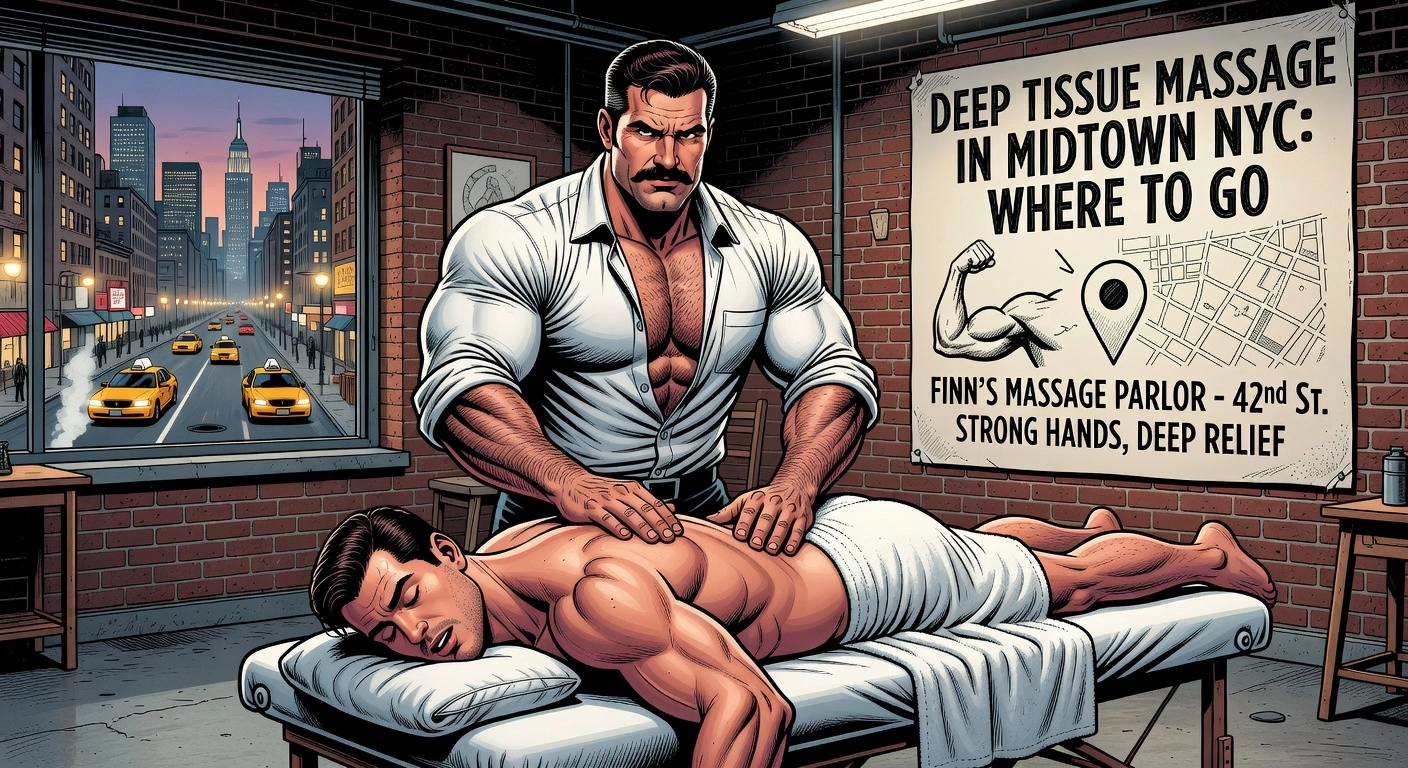
Finding the right place for a deep tissue massage in Midtown NYC can feel overwhelming. The neighborhood is packed with options, ranging from luxury spas to no-frills wellness clinics, and not all of them deliver the therapeutic results you are actually looking for. Whether you are dealing with chronic muscle tension, recovering from an injury, or simply need a skilled therapist who understands how to work through stubborn knots, the quality of your experience depends entirely on where you go.
This guide cuts through the noise and brings you a curated list of the best spots for deep tissue massage in Midtown NYC, each selected based on therapist expertise, client outcomes, and overall value. You will learn which studios specialize in true clinical-grade deep tissue work, what to expect in terms of pricing and booking, and how to match your specific needs to the right provider. If you have had a deep tissue massage before and want more than just a firm rubdown, this list will help you find exactly what you need.
What to Look for in a Midtown Deep Tissue Studio
Not every studio advertising deep tissue massage in Midtown NYC is equipped to deliver it properly. These five criteria separate studios that were built for your experience from ones that simply accommodate it.
1. Licensing and Credentials
New York State holds massage therapists to a 1,000-hour training standard, one of the strictest requirements in the country. For deep tissue work specifically, this matters because sustained pressure applied without proper anatomical knowledge can bruise tissue, aggravate injuries, or compress nerves. A licensed therapist knows how to screen contraindications, warm the tissue progressively, and calibrate pressure using forearms and elbows with precision. Always verify LMT credentials before booking, not after.
2. Environment Fit
The intake process tells you everything. Studios serious about therapeutic outcomes ask about your medical history, chronic pain patterns, and movement goals before the session begins. The physical space should feel intentional and calm, not rushed or generic. If a studio's atmosphere signals that you were an afterthought rather than the target client, that tension carries into the room.
3. Discretion and Appointment Structure
Appointment-only models with private suites protect your experience in ways walk-in spas structurally cannot. You get a specific therapist, a dedicated room, and zero interruptions. At Menquility, every session is by appointment only in a private suite, which means the environment is controlled, consistent, and fully focused on your session from the moment you arrive.
4. Identity Alignment
A studio explicitly built for gay, bi, and curious men changes the quality of the work beyond technique alone. Cultural competence reduces the ambient tension that often goes unacknowledged in general wellness spaces. When you are not managing how you present yourself, you relax more completely, and deeper therapeutic work becomes possible.
5. What to Ask Before Booking
Ask whether sessions run 60, 90, or 120 minutes, and whether the therapist has direct experience with your specific problem areas, whether that is chronic lower back tension, desk-posture strain, or post-training recovery. Ask what distinguishes their deep tissue approach from generic pressure massage. Therapeutic deep tissue uses trigger point work, cross-fiber friction, and sustained loading of specific muscle groups. If a studio cannot articulate that distinction clearly, treat it as a signal.
Top Deep Tissue Massage Studios in Midtown NYC
Knowing what to look for is only half the equation. The other half is knowing where to actually book. Midtown Manhattan has no shortage of massage studios, but the gap between a generic table-and-oil setup and a genuinely therapeutic, identity-affirming experience is significant. Here is a breakdown of the top options available right now, ranked not by prestige alone but by what each studio actually delivers across the criteria that matter most.
Menquility — Kips Bay, Manhattan NYC. By appointment only. Contact the concierge for arrival details.
Menquility is the only queer-owned, M4M-specific therapeutic massage studio operating as a brick-and-mortar space in Midtown NYC, and that distinction is not a marketing footnote. It is the entire architecture of the experience. Licensed gay-affirming therapists deliver deep tissue work in private suites designed around masculine sensibility: matte textures, amber lighting, and acoustic dampening that creates genuine auditory privacy. Sessions run 60, 90, or 120 minutes, with the longer formats especially well-suited to full-body deep tissue work targeting chronic tension in the back, hips, glutes, and shoulders.
What separates Menquility from every other studio on this list is the explicit positioning. The studio was built for gay, bi, and curious men, full stop. There is no navigating an ambiguous welcome, no wondering whether the environment will feel comfortable or safe, and no mixed-gender waiting room dynamic. The appointment-only model reinforces that privacy is structural rather than incidental. You book directly by calling or texting +1 (646) 347-1740, or via concierge@menquility.com, and the entire interaction is handled with discretion from the first message to the last minute of your session. For men seeking deep tissue massage in Midtown NYC who also want an affirming, judgment-free environment, this is the clear first choice.
2. Noble Men's Spa (274 Madison Ave, Midtown East)
Noble Men's Spa occupies a well-appointed suite at 274 Madison Avenue and positions itself as a luxury sanctuary for gentlemen seeking discreet, high-quality bodywork. Deep tissue is available and delivered by skilled therapists in a private, refined setting. The studio identifies as LGBTQ+ friendly and maintains a tone of exclusivity that aligns with its Midtown East address. Booking is handled online through Fresha, with sessions available daily until late evening.
Noble is a strong option for men who prioritize luxury finish and discretion in a professional environment. However, it does not carry the explicitly queer-owned identity or M4M-specific welcome messaging that defines Menquility. Being LGBTQ+ friendly and being built specifically for gay and bi men are meaningfully different things, and that distinction matters depending on how central identity comfort is to your decision. Noble is a credible peer in the Midtown men's spa space, but it is not the same category of experience for clients who want their identity reflected in the studio's core mission rather than its policy footnotes.
3. Bodyworks DW Midtown West (336 W 37th St, Suite 710)
Bodyworks DW operates with a clinical and orthopedic orientation that makes it a strong fit for a specific type of client: one dealing with injury recovery, postural dysfunction, or chronic musculoskeletal pain that requires structured assessment and targeted intervention. The studio uses myofascial release techniques alongside deep tissue methods, and therapists typically conduct an intake evaluation before tailoring each session. NYS-licensed therapists and a second Financial District location reflect operational consistency and professional credibility.
The limitation here is purely about focus. Bodyworks DW does not offer any community identity positioning, and its clinical environment, while excellent for results-driven therapeutic needs, reads as neutral and functional rather than welcoming in a queer-affirming sense. For a client whose primary need is medical-grade deep tissue work for a specific injury, this studio belongs on the shortlist. For a client weighing therapeutic depth alongside identity comfort and privacy, it addresses only one of those criteria.
4. ila Only Spa (455 Madison Ave, Lotte New York Palace)
ila Only Spa brings an organic and sustainability-driven philosophy to its deep tissue and sports massage offerings, operating out of the Lotte New York Palace hotel on Madison Avenue. The use of ethically sourced products adds a dimension of intention to the experience that appeals to clients who care about what goes on their skin alongside the mechanical benefits of the massage itself. Sessions are available in flexible durations and the luxury hotel setting delivers a polished, quiet environment.
The tradeoff is breadth. ila serves a wide demographic including couples and expectant mothers, which shapes the overall atmosphere. There is no queer-specific or M4M targeting, and the hotel spa context, while certainly comfortable, does not carry the focused masculine identity of a studio built with a specific clientele in mind. For deep tissue with premium product ingredients and hotel-level amenities, ila is a legitimate option. For men who want their identity centered in the experience itself, it falls short of studios built with that intention.
5. Massage Envy Midtown West (525 W 42nd St)
Massage Envy at 525 West 42nd Street offers the most accessible entry point on this list, with customizable sessions, predictable pricing, and convenient proximity to the Port Authority and Times Square transit corridors. Professional therapists deliver deep tissue work in a mixed-gender, chain-format environment, and the membership model makes recurring sessions financially manageable for clients who prioritize consistency and affordability.
What Massage Envy does not offer is any form of specialized positioning. The format is generic by design, built for volume and broad accessibility rather than depth of identity, privacy architecture, or clinical specificity. For a client whose sole criterion is convenience and cost, this is a workable option. For anyone weighing therapeutic quality, community identity, or discretion alongside the basics, the other studios on this list deliver meaningfully more.
How to Weigh These Options Against Your Priorities
The right studio depends on which criteria carry the most weight for your specific situation. If therapeutic depth and clinical precision are the primary concern, Bodyworks DW's orthopedic approach is the strongest match. If organic product quality and luxury hotel atmosphere appeal, ila delivers on both counts. If accessibility and price are the deciding factors, Massage Envy removes most friction.
Menquility — Kips Bay, Manhattan NYC. By appointment only. Contact the concierge for arrival details.
Deep Tissue vs. Swedish and Other Modalities: Which One Do You Need
Choosing the right modality is not a minor detail. It is the difference between a session that addresses your actual problem and one that leaves you relaxed but unchanged.
The Mechanical Difference
Deep tissue massage operates on fundamentally different principles than Swedish. Where Swedish uses lighter-to-moderate pressure with long, flowing strokes to stimulate circulation and ease surface-level tension, deep tissue employs slower, more deliberate movements with sustained, concentrated pressure applied through elbows, forearms, and knuckles. The goal is to penetrate beyond superficial muscle into deeper layers of fascia and connective tissue, breaking down adhesions and chronic knots that standard techniques cannot reach. According to Healthline's breakdown of the two modalities, deep tissue builds on some Swedish foundations but applies significantly greater targeted intensity to specific problem areas rather than delivering a full-body gentle experience.
Who Deep Tissue Is Actually For
Deep tissue is the right call when your body has a specific structural complaint. Chronic tension from desk posture, lower back pain, restricted shoulder mobility, sports recovery, and repetitive strain injuries are the documented top reasons men book this modality in 2026. If you spend eight-plus hours at a desk in Midtown, the accumulated compression in your neck, upper traps, and lumbar spine is not something Swedish strokes will resolve. Deep tissue addresses those layers directly, improving blood flow, reducing inflammation, and restoring range of motion in ways that carry measurable outcomes beyond the table.
When to Choose Differently
Swedish or blended modalities serve you better under specific conditions. If you are managing acute stress, general fatigue, first-time nerves, or simply need mental reset over physical repair, Swedish delivers without unnecessary intensity. Thai massage suits clients seeking improved mobility and energetic flow through assisted stretching and acupressure. Hot stone therapy uses therapeutic heat to release muscle tension with less manual pressure, and aromatherapy layers sensory and mood benefits alongside gentler technique. The physical state you arrive in should drive the modality you choose.
Menquility's Approach to Modality Matching
At Menquility, no session is locked into a fixed format before the therapist understands what your body needs that day. The full menu, covering deep tissue, Swedish, Thai, and hot stone, exists so your session can be shaped around your actual condition rather than a standardized script. A therapist may integrate deep tissue pressure into a session that opens with Swedish techniques, or shift toward hot stone when the body resists depth. That flexibility is a clinical advantage, not a marketing claim.
The Results-Driven Shift in Men's Wellness
Men's massage preferences in 2026 have moved decisively toward measurable outcomes. Improved range of motion, reduced inflammation, faster athletic recovery, and relief from postural strain have replaced "relaxation" as the primary booking motivation for a growing share of male clients. The men's wellness segment is expanding at an 8.0% CAGR through 2030, and deep tissue consistently leads as one of the most-requested modalities precisely because it delivers outcomes men can feel and measure session over session.
Why Identity-Affirming Spaces Change the Deep Tissue Experience for Gay and Bi Men
The 346% surge in male spa-goers since 2018 reflects a fundamental cultural shift in how men relate to therapeutic bodywork. Gay and bi men are part of that wave, but with a distinction: they are no longer willing to accept spaces that are merely tolerant. Tolerance means a front desk that is professionally polite. Affirmation means a therapist who was hired specifically because they understand your experience, a room where you do not have to calculate whether you are welcome, and a brand that built its entire identity around men like you. Those are not equivalent experiences, and for a modality as physically demanding as deep tissue, the difference matters.
What No Intake Anxiety Actually Feels Like in Practice
In a generic spa or with an unknown independent masseur, gay and bi men often arrive carrying a secondary layer of tension: reading the room, deciding how much to disclose on an intake form, wondering whether the therapist's energy will shift once they pick up on something. That performance takes real physiological energy. At a studio like Menquility, where every therapist is hired for gay-affirming practice and the space was built explicitly as an M4M sanctuary, that layer simply does not exist. No reading the room. No hedging. Just the work. For a deep tissue session targeting chronic lumbar tension or shoulder adhesions, arriving already at baseline is a meaningful clinical advantage.
Psychological Safety Is a Therapeutic Variable, Not Just a Preference
Research consistently shows that massage reduces cortisol by approximately 31% on average, while simultaneously increasing serotonin and dopamine. What the data also supports is that psychological safety amplifies this effect. When a client feels genuinely comfortable, the parasympathetic nervous system activates more fully, baseline muscle guarding decreases, and the therapist can access deeper tissue layers without the client unconsciously bracing. Identity-fit accelerates that process. Comfort is not a luxury add-on to deep tissue work; it is a mechanism that determines how effectively the session can address chronic tension.
Licensed Studio Accountability vs. Directory Listings
Platforms like RentMasseur or MasseurFinder primarily aggregate independent masseurs. Quality, licensing status, and training vary widely by individual, and many operate without formal certification or consistent safety protocols. Menquility operates as a licensed brick-and-mortar studio with regulated operations, verified gay-affirming therapists, business insurance, and consistent standards applied across every session. That structural accountability is not a minor detail. It means every booking carries the same baseline of safety, professionalism, and therapeutic integrity, regardless of which therapist you see.
Filling a Real Gap in Midtown's Wellness Landscape
Prior to dedicated options, gay, bi, and curious men in Midtown were navigating a fragmented market: generic day spas with no explicit affirmation, hotel spas optimized for mixed corporate clientele, and a loose network of unregulated independents offering everything from legitimate deep tissue to services with no therapeutic basis. No dedicated, licensed, queer-owned studio existed to serve this population with consistency. What filling that gap looks like in practice is a private, appointment-only suite in a central Midtown location, a menu anchored in licensed therapeutic modalities, and marketing that removes the burden of vetting entirely. You should not have to investigate whether a massage studio will make you feel like a full person. That should be the starting point.
Getting to Menquility from Anywhere in Manhattan
Menquility — Kips Bay, Manhattan NYC. By appointment only. Contact the concierge for arrival details.
Subway Access
Multiple lines converge at two stations within a block of the studio: 34th St-Herald Square (B, D, F, M, N, Q, R, W) and 34th St-Penn Station (1, 2, 3, A, C, E). From the Upper West Side, the 2 or 3 express runs roughly six to seven minutes from 72nd St. From the Upper East Side, the 6 train reaches the area in under 15 minutes. Greenwich Village riders on the N, R, or W arrive in approximately ten minutes total door to door.
Penn Station, PATH, and Out-of-Borough Access
Clients arriving from New Jersey have two reliable options: NJ Transit directly into Penn Station, which is a two-minute walk from the studio entrance, or the PATH train to 33rd St, equally close. Brooklyn and Queens riders can connect via LIRR to Penn Station or transfer to converging subway lines at key hubs. Street parking in Midtown is limited and typically expensive; garage options near Herald Square are available through booking apps, but transit is the practical choice for most visitors.
Booking Before You Travel
All sessions at Menquility are by appointment only. No walk-ins are accepted. The studio operates daily from 10am to 10pm, offering significant flexibility for post-work and evening bookings. Same-day slots are sometimes available, particularly on Friday and Saturday evenings. Book by calling or texting +1 (646) 347-1740, or email concierge@menquility.com to confirm availability before making the trip.
How to Book a Deep Tissue Session at Menquility
Booking your first deep tissue session at Menquility takes less than five minutes and sets the tone for everything that follows. Reach the team by calling or texting (646) 347-1740, or by emailing concierge@menquility.com. There is no impersonal online queue to navigate. Direct contact is intentional: it creates space for a real intake conversation before you ever arrive, ensuring the right therapist and session structure are ready for you.
When you reach out, come prepared with three pieces of information. First, your preferred session length: 60 minutes for targeted single-area work, 90 minutes for the most balanced deep tissue session across multiple zones, or 120 minutes for full-body therapeutic depth without any rushing. Second, your primary target areas, whether that is chronic neck and shoulder tension from desk work, lower back compression, or hip tightness from training. Third, any injury history, sensitivities, or pressure preferences the therapist should factor in from the start. You can review Menquility's FAQ and pricing page before booking to arrive fully informed.
On arrival, you step directly into a private climate-controlled suite. There are no shared waiting areas, no walk-in clients overlapping your appointment, and no front-desk small talk that tests your patience. Your licensed, gay-affirming therapist conducts a brief in-room intake, then builds the session around what your body actually presents that day. Therapists routinely blend deep tissue pressure with complementary modalities, incorporating hot stone heat to soften dense tissue faster, or Thai-influenced stretching to address mobility alongside chronic tension.
The appointment-only model is not a constraint; it is the mechanism that makes superior outcomes possible. A therapist who knows your history, has uninterrupted time, and works in a private suite with no clock pressure delivers measurably more effective therapeutic work than any high-volume walk-in format can. For gay, bi, and curious men navigating wellness spaces that rarely center their experience, that combination of clinical precision and affirming environment is the entire point.
Finding the Right Deep Tissue Studio in Midtown NYC
A genuinely therapeutic deep tissue session stands apart from a generic pressure massage in four measurable ways: verified licensing, a purpose-built environment, identity fit, and structured session design. In New York State, licensed massage therapists complete a minimum of 1,000 instructional hours before earning credentials. The environment matters equally; private suites, acoustic privacy, and proper draping protocols allow clinical work to happen without distraction. Identity fit reduces the psychological friction that prevents men from fully surrendering to treatment. Session structure, including intake assessment, targeted technique sequencing, and post-session guidance, transforms pressure into outcome.
Menquility addresses a specific, documented gap. Midtown's wellness landscape offers no other licensed, brick-and-mortar studio built explicitly around a queer-owned, M4M therapeutic model. Gay hands, queer care, and professional credentials occupy the same room here, and that combination remains genuinely rare.
Menquility — Kips Bay, Manhattan NYC. By appointment only. Contact the concierge for arrival details.
Conclusion
Finding the right deep tissue massage in Midtown NYC does not have to be a guessing game. The best providers combine clinical expertise with genuine therapeutic outcomes, not just firm pressure. Pricing and booking logistics vary widely, so knowing what to expect ahead of time saves you time and frustration. Most importantly, matching your specific needs to the right studio makes all the difference between relief and disappointment.
Now that you have a clear picture of your options, take the next step. Book a session with one of the recommended providers on this list and experience what a skilled deep tissue therapist can actually do for your body. Your muscles have been waiting long enough. Stop settling for mediocre results and invest in the quality of care your body genuinely deserves.