Journal / June 15, 2026
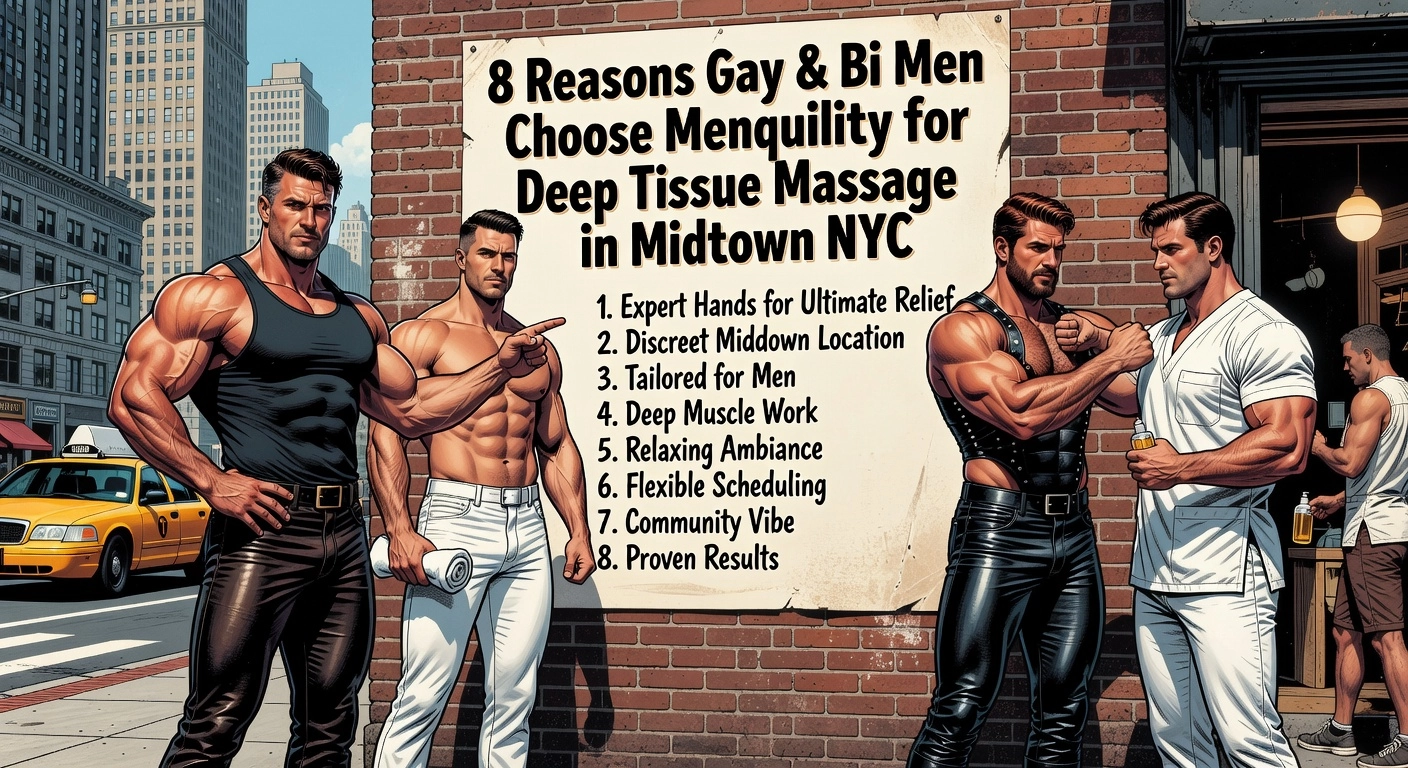
8 Reasons Gay & Bi Men Choose Menquility for Deep Tissue Massage in Midtown NYC
Gay-owned deep tissue massage in Midtown NYC. Licensed M4M therapists. Private suites. Zero judgment. Serving gay, bi and curious men daily 10am-10pm.
By Menquility Team
Finding a truly affirming, skilled massage therapist in New York City can feel overwhelming, especially when you want more than just technical competence. For gay and bisexual men seeking deep tissue massage NYC Midtown has no shortage of options, but not every spa or therapist creates a space where you can fully relax and be yourself.
Menquility has built a reputation as the go-to destination for gay and bi men who prioritize both therapeutic quality and genuine comfort. Whether you are managing chronic muscle tension, recovering from an intense workout, or simply need to decompress from the demands of city life, the experience you choose matters enormously.
In this post, we break down eight specific reasons why so many gay and bi men consistently return to Menquility for their deep tissue work. From the inclusive environment and therapist expertise to the thoughtful booking process and Midtown location, each factor plays a meaningful role in the overall experience. By the end, you will have a clear picture of what sets Menquility apart in one of the most competitive wellness markets in the world.
Licensed M4M Therapists Who Actually Know How to Apply Pressure
For many gay and bi men seeking serious therapeutic work, the preference for a male therapist is not just personal comfort, it is practical. Male therapists typically bring greater physical strength, allowing them to sustain firm elbow, forearm, and knuckle pressure across an entire session without fatiguing. That sustained pressure is exactly what deep tissue work demands. Shared body awareness matters too. A therapist who understands how a male body holds tension, where gym training accumulates tightness in the lats and glutes, or how hours at a desk locks up the thoracic spine, can target those areas with far greater precision than generalized technique allows.
Menquility's licensed M4M therapists are not a random roster pulled from a generic staffing pool. The team is intentionally curated, with each therapist holding a New York State massage license and selected specifically for their deep tissue capability. Specialist roles include a Recovery and Sports Specialist for athletic recovery and a Lead Therapist focused on layered deep bodywork. This means your session is matched to your actual tension profile, not a one-size approach.
The difference between deep tissue and a light relaxation massage is significant and worth understanding. Swedish massage uses long, gliding strokes at light-to-medium pressure, calming the nervous system but rarely reaching the stubborn adhesions buried beneath the superficial muscle layers. Deep tissue massage works with slow, deliberate cross-fiber strokes using forearms and knuckles to break up scar tissue, release fascia restrictions, and restore blood flow to chronically compressed areas including the back, shoulders, hips, and glutes. For men carrying desk-job posture damage or post-gym soreness, that distinction is everything.
The clinical outcomes are well-documented. Deep tissue work improves circulation, reduces chronic inflammation, enhances range of motion, and directly addresses the trigger points that cause referred pain patterns. It is not a luxury, it is maintenance.
Then there is the environment itself. At Menquility, the gay-affirming M4M dynamic removes an invisible tax that most queer men carry into mainstream spas: the low-level work of managing someone else's discomfort. Here, there is no awkwardness, no guesswork, and no need to edit yourself. You arrive, you receive, and the work actually lands.
A Private Suite, Not a Curtained-Off Corner
There is a fundamental difference between a room with a curtain and a room with a door. In high-volume franchise settings, treatment areas are often divided by thin partitions or draped dividers within a larger shared space. Sounds from adjacent tables bleed through. Footsteps, muffled conversations, and equipment noise become constant background distractions. You are technically in your own space, but you are never fully alone. For deep tissue work, that distinction matters enormously.
Menquility operates on a completely different model. Every session takes place in a fully enclosed private suite, booked exclusively for one client per appointment. There are no shared waiting areas, no strangers moving through adjacent spaces, and no overlapping session noise to pull your nervous system back toward alertness. Because the studio is appointment-only, your suite is prepared before you arrive: table temperature set, lighting adjusted, session materials ready. The entire environment is calibrated around your session, not a rotating schedule of walk-ins.
This matters physiologically, not just philosophically. Deep tissue massage requires the body to release chronic holding patterns in the muscle and fascia. That release depends heavily on parasympathetic activation, the nervous system state associated with safety and rest. Warm, consistent room temperature prevents the subtle muscle guarding that cold air triggers. Dim, controlled lighting signals the brain to lower its alert threshold. Complete acoustic privacy removes the low-grade social vigilance that keeps muscles partially contracted even on a treatment table.
For men who have felt exposed or quietly uncomfortable in generic spa settings, discretion is not a bonus feature; it is a direct therapeutic variable. Involuntary muscle guarding rooted in social anxiety or self-consciousness limits how effectively a therapist can work through deeper tissue layers. A setting built around privacy and affirmation removes that resistance before the session even begins.
Menquility — Kips Bay, Manhattan NYC. By appointment only. Contact the concierge for arrival details.
Zero Judgment. Full Stop.
Even well-intentioned mainstream spas carry invisible assumptions baked into their intake forms, their language, and the general energy of the space. A receptionist asking about "your wife" before a couples add-on, a therapist defaulting to small talk that presumes a straight domestic life, or simply the absence of any visible signal that gay, bi, or curious men are genuinely welcome here, these small moments accumulate. According to KFF survey data, roughly 65% of LGBT adults report experiencing at least one form of discrimination in a given year, compared to approximately 40% of non-LGBT peers. In bodywork settings, that ambient guardedness does not disappear at the door. It travels onto the table.
Menquility is built differently, from the ground up. As a queer-owned spa in Midtown Manhattan, every element of the environment, therapist selection, suite design, intake process, and brand voice, centers gay, bi, and curious male clients as the primary audience, not a secondary accommodation. This is not a generic day spa that has added a pride flag to its homepage. The identity is structural.
That distinction carries real physiological weight. When a client does not need to monitor how he phrases something, manage a therapist's potential discomfort, or brace against an offhand comment, the nervous system settles. That settled state is not incidental to deep tissue work; it is prerequisite. Muscular guarding rooted in psychological vigilance actively resists the firm, sustained pressure required to release chronic adhesions in the deeper tissue layers. Safety is therapeutic technique.
Menquility — Kips Bay, Manhattan NYC. By appointment only. Contact the concierge for arrival details.
Body positivity and gay-affirming care are not features Menquility layers onto an otherwise standard massage. They are the architecture. Men who have spent years navigating spaces that were not built for them often arrive carrying tension that has less to do with desk posture and more to do with the accumulated cost of being underserved. At Menquility, the entire session is designed to address both.
Centrally Located Steps from Penn Station, Herald Square, and Koreatown
Menquility — Kips Bay, Manhattan NYC. By appointment only. Contact the concierge for arrival details.
That coverage translates directly to the neighborhoods Menquility serves. From Chelsea, the 1 train puts you here in under five minutes. Hell's Kitchen clients can take the A, C, or E one stop and walk east on 32nd Street, or check current MTA accessibility options for the most direct route. The Upper West Side is a six to seven minute express ride on the 2 or 3. The Upper East Side connects via the 6 train in roughly twelve minutes. Murray Hill is practically a walk around the corner.
The Yelp listing for Menquility reflects what repeat clients already know: the location removes friction. Booking a deep tissue session during a lunch break, directly after office hours, or on a Saturday afternoon in the city requires no detour and no planning acrobatics. Midtown has one of the densest concentrations of office workers in the country, and the 32nd Street address is built for exactly that reality.
Proximity to Koreatown adds another dimension entirely. The 32nd Street corridor between Fifth Avenue and Broadway has long anchored a wellness and bodywork culture in Manhattan. Men who already navigate this block for Korean spa traditions and therapeutic bodywork will find Menquility a natural, unapologetic extension of that same ethos, just tailored specifically to gay, bi, and curious men who want strong pressure and a judgment-free room.
Daily hours running from 10am to 10pm by appointment mean the studio genuinely works across schedules without compromise. Early risers can book before the workday builds momentum. After-work appointments absorb the tension of a long session at the desk. Late-evening slots serve those who decompress best when the city finally quiets down. Call or text (646) 347-1740 or email concierge@menquility.com to lock in your time.
Deep Tissue Work That Actually Targets Your Problem Areas
Every deep tissue session at Menquility begins before hands ever touch skin. Therapists conduct a focused intake conversation to identify the specific problem zones a client brings through the door. Whether that is lower back compression from a daily commute, IT band tightness from marathon training, or shoulder impingement from years of overhead pressing, that initial exchange shapes everything that follows. This is not a checkbox exercise. It is a clinical conversation that maps the session before it starts, so pressure lands where it actually needs to go.
The difference between a rote deep tissue session and a targeted one comes down to precision. A generic session moves through the body on autopilot, applying uniform pressure without accounting for individual tissue density or chronic holding patterns. At Menquility, therapists use what practitioners call pressure mapping, concentrating sustained, slow strokes across specific muscle grain to break up adhesions and release fascial restriction in identified zones. Communication stays open throughout. Clients provide real-time feedback on intensity, and therapists adjust accordingly, using knuckles, forearms, or elbows to reach depth without tipping into counterproductive pain. Skilled therapists understand that precision-based work produces faster, longer-lasting results than generalized approaches.
The client profile at Menquility reflects the realities of gay and bi men living and working in New York City. Gym-related soreness and athletic recovery are common entry points. So is postural dysfunction from hours of desk work, presenting as forward-head posture and chronic upper back tension. Hip flexor tightness shows up constantly, whether from heavy squatting or prolonged sitting. And stress-carried tension in the neck and traps is almost universal among men navigating the pace of Midtown. According to AMTA data, 49 percent of massage clients seek treatment for soreness or stiffness, with chronic pain relief cited by 42 percent.
Deep tissue does not operate in isolation at Menquility. Sessions can be customized to integrate complementary modalities based on what the body needs that day. Hot stone work can precede deeper pressure, warming tissue and increasing pliability before more intense work begins. Thai elements bring assisted stretching and range-of-motion gains that pure deep tissue cannot achieve alone. Swedish strokes serve as transition work, easing the nervous system into and out of deeper layers without abrupt shifts in intensity.
Session length is a clinical variable, not just a scheduling preference. A 60-minute booking works well for isolated problem areas, one or two zones treated with focused depth and adequate time to decompress before the session closes. Chronic full-body tension requires 90 to 120 minutes to address properly. That window allows therapists to move through multiple regions, layer modalities, and give each problem zone the sustained attention it needs without rushing. Compressed sessions consistently underdeliver on deep tissue outcomes.
The Masculine Sanctuary Energy Generic Spas Cannot Fake
There is an atmosphere that exists in certain spaces that cannot be manufactured through a coat of paint or a playlist curated for "relaxation." Generic day spas broadcast it immediately: lavender diffusers, watercolor botanicals on the walls, soft feminine typesetting on the signage. It is not unwelcoming, but it is clearly built for someone else.
Menquility makes different choices at every level. Matte textures, amber lighting, acoustic privacy, and heated tables in sealed private suites create an environment that reads masculine without announcing itself loudly. The absence of floral, tourist-friendly decor is deliberate. What replaces it is a stripped-down calm that allows the body to settle without the low-level cognitive friction of navigating a space that was never designed with you in mind.
That design intelligence comes directly from ownership. Menquility was founded by gay men who spent years as clients in spaces that were technically inclusive but operationally indifferent. That lived experience shapes every hiring decision, every intake protocol, and every physical detail of the studio. Queer-owned does not mean a rainbow sticker on the door; it means the values of the founders are embedded in how the business actually runs.
The psychological difference is measurable in how deeply a client can release. Being tolerated and being centered are not the same thing. When a man walks into a room built specifically for him, the mental overhead of self-monitoring drops. The body follows. That is the precondition for serious therapeutic work.
"Gay hands. Queer care. Full stop." and "Where men come undone." are not tagline exercises. They are operational promises with receipts: licensed M4M therapists, appointment-only private suites, and an identity that does not soften itself for broader appeal.
Appointment-Only Means Your Session Is Never Rushed
Walk-in volume models are built on a simple, damaging premise: the next client is already waiting. That pressure compresses everything. Therapists skip thorough intake conversations, abbreviate warm-up sequences, and ration their time on problem areas because the schedule demands turnover, not results. Clients feel it too. A session that should address chronic shoulder tension or lower back restriction instead becomes a generalized rubdown that checks boxes without resolving anything. The factory-floor 50-minute slot is not a therapeutic session; it is a managed transaction.
Menquility operates on a different logic entirely. Every session is booked in advance, which means therapists arrive at each appointment knowing the client's focus areas, pressure preferences, and any relevant history. There is no walk-in queue pushing against the session's end. The full duration belongs to the client, without interruption, without compression, without a knock at the door signaling that someone else is waiting in the lobby.
The difference this makes to a deep tissue session is structural. A properly paced 60-minute or 90-minute appointment begins with 10 to 15 minutes of lighter effleurage strokes to increase blood flow and prepare the tissue for depth. Sustained, focused pressure on chronic tension zones follows, with time for real-time client feedback and technique adjustments. The session closes with deliberate cool-down strokes that reduce post-session soreness and support the body's integration of the work. Research on chronic neck pain supports this approach directly; studies found that 60-minute focused sessions produced meaningfully better outcomes than shorter, more frequent appointments that never allowed sufficient tissue response time.
Booking at Menquility requires no app, no membership, and no upsell conversation. Call or text +1 (646) 347-1740 or email concierge@menquility.com to schedule. That is the entire process.
Book in Under 2 Minutes. Show Up. Let Go.
Menquility — Kips Bay, Manhattan NYC. By appointment only. Contact the concierge for arrival details.
Between booking and arrival, preparation is minimal by design. Hydrate, wear something comfortable, skip the heavy pre-session meal. That is essentially the entire checklist. The simplicity is intentional, because the session itself carries all the weight.
First-time clients are handled with the same directness. The intake process is brief, discreet, and focused entirely on identifying where your body needs work. There is no awkward orientation, no sales pitch for add-ons, no laminated menu of upgrades to review. You communicate your pressure preferences and problem areas, and the therapist gets to work.
Daily availability from 10am to 10pm means a slot exists whether you are blocking a lunch break, winding down after a late meeting, or making a weekend afternoon worthwhile.
The booking model reflects exactly what Menquility is: no membership fees, no upsell sequences, no corporate infrastructure wrapped around a simple human transaction. Just a direct line and a private suite ready when you are.
Ready to Book Your Deep Tissue Session in Midtown NYC
Menquility — Kips Bay, Manhattan NYC. By appointment only. Contact the concierge for arrival details.
Sessions run 60 to 120 minutes, and same-day or next-day availability is frequently open. Booking takes less than two minutes. Call or text +1 (646) 347-1740, or email concierge@menquility.com. The studio operates daily from 10am to 10pm, by appointment only.
Gay hands. Queer care. Full stop. Your deep tissue session is waiting. Come undone.
Conclusion
Choosing the right massage therapist goes beyond finding someone with strong hands. For gay and bi men in New York City, it means finding a space where skill, safety, and genuine affirmation come together seamlessly. Menquility delivers on all three fronts, combining expert deep tissue technique with an environment where you can fully exhale and be yourself. The Midtown location, thoughtful therapists, and inclusive culture remove every barrier between you and real therapeutic relief.
You deserve a massage experience that honors both your body and your identity. Do not settle for anything less. Book your deep tissue session at Menquility today and discover firsthand why so many gay and bi men keep coming back. Your body has been carrying enough. It is time to put it in the right hands.