Journal / July 1, 2026
Chinatown Massage NYC: What Gay Men Need to Know Before They Book
No gay-affirming massage exists in Chinatown NYC. Here's what queer men should know before booking, and a better option 4 stops away.
By Menquility Team
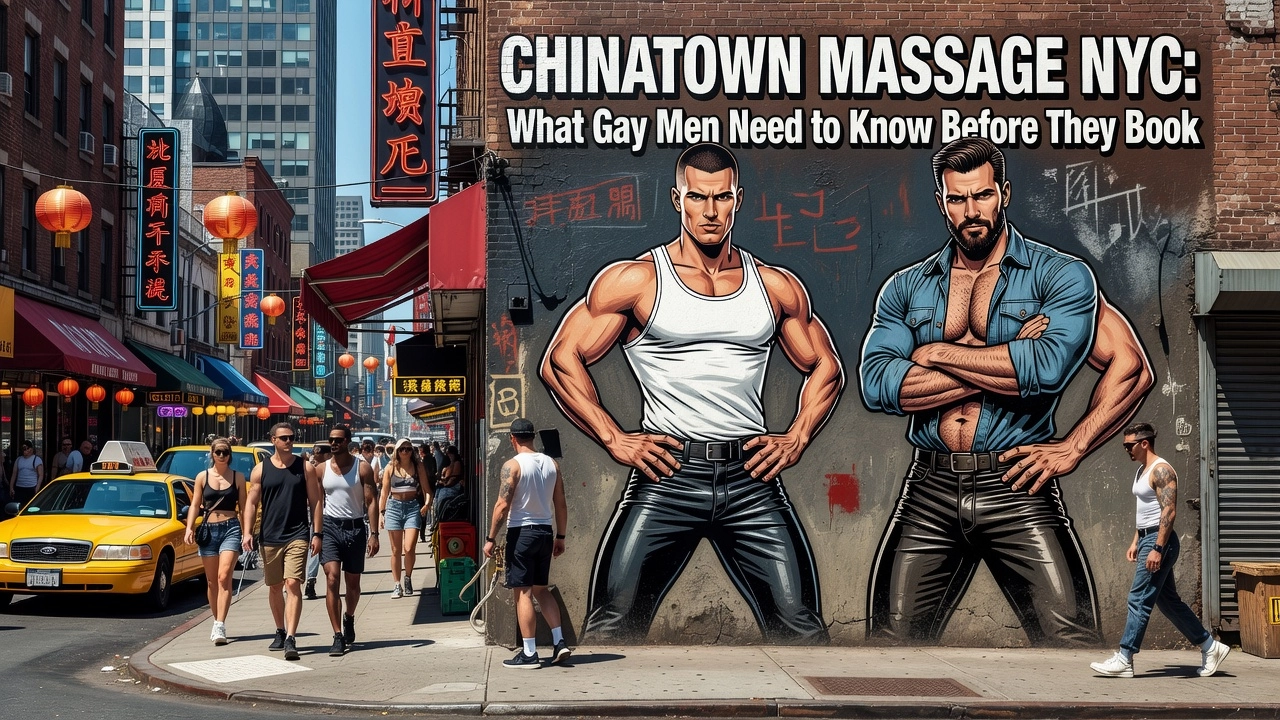
So you've heard whispers about Chinatown massage NYC spots and you're curious what the deal is. Maybe a friend mentioned it, or you stumbled across something online and now you're wondering if these places are actually gay-friendly or if you'd be walking into an awkward situation. Totally valid question, and you're not alone in asking it.
Here's the thing: Chinatown in Manhattan has a huge range of massage options, from completely legitimate therapeutic spots to the kind of places that operate in a legal gray area. For gay men who are new to navigating this scene, knowing the difference before you book can save you a lot of confusion, wasted money, or uncomfortable moments.
In this post, we're breaking it all down in plain language. You'll learn how to spot the different types of establishments, what to realistically expect at each one, how to find places where you'll actually feel welcome, and what red flags to watch for. Think of this as your no-nonsense beginner's guide to making a smart, confident choice.
What the Chinatown Massage Scene Actually Looks Like
If you've ever searched "chinatown massage nyc" and started scrolling through options, you've probably noticed that the neighborhood has a pretty well-established scene. The anchor of it all is Renew Day Spa, located at 10 Bowery and operating since 2012. It's open until midnight, walk-ins are welcome, and pricing starts at $55 for a 60-minute body massage. Their weekday special brings a full two hours of bodywork down to $99 (regularly $149), and a 90-minute body and foot combo runs $80. For spontaneous, budget-friendly relief after a long day, that's a genuinely appealing offer.
A quick look at the Renew Day Spa service menu tells you a lot about the model. Services are standardized, modalities are clearly listed, and therapist selection isn't part of the picture. You show up, you get a massage, you leave. That works for a lot of people. There's also Why Not Men's Spa in the nearby West Village, offering massage and grooming services ranging from $40 to $130, targeting a general male audience with no identity-specific positioning.
Here's the honest part, though. This market is built for volume and anonymity. Neither Renew nor the nearby alternatives offer any queer affirmation, no ability to request a therapist whose identity aligns with yours, and no indication that the space was designed with your comfort in mind specifically. For a lot of gay, bi, or curious men, walking into an unfamiliar room with an unknown therapist isn't just an inconvenience; it's a genuine source of anxiety. Affordable and accessible is great. But it's not the same as private, intentional, and affirming.
There Are No Gay-Affirming Massage Options in Chinatown
Let's be direct about something: if you searched for a gay-affirming massage in Chinatown, you came up empty because there is nothing there to find.
A Yelp search for "Gay Male Spa" in Chinatown, Manhattan does not return a short list or a handful of so-so options. It returns nothing at all. Zero results. That is not a ranking problem or a gap in Yelp's database. It is an accurate reflection of what exists in that neighborhood for queer men looking for an affirming experience.
The established providers in the Chinatown area, including Renew Day Spa and Why Not Men's Spa, simply were not built with gay or bi men in mind. There is no LGBTQ+ language in their branding, no affirmation signals in their service descriptions, and no indication in their therapist bios that queer clients were part of the vision. That is not a criticism of those businesses. They serve their intended audience well. But walking in as a gay or bi man means entering a space that was never designed to make you feel seen or understood, and there is a real difference between being technically allowed somewhere and actually feeling welcome.
The pattern holds across the broader [NYC M4M massage landscape](https://www.masseurfinder.com/massage/new_york/). Affirming providers cluster in Hell's Kitchen, Greenwich Village, and the Theater District. Chinatown and Lower Manhattan simply do not appear on that map at all.
Naming this gap honestly matters. If you searched "Chinatown massage NYC" hoping to find something built for you, the most useful thing anyone can tell you is that it does not exist there. Knowing that saves you time, and it saves you the discomfort of walking into an environment that was never set up to welcome you the way you deserve.
What a Queer-Affirming M4M Massage Actually Means in Practice
There is a meaningful difference between a spa that will tolerate a gay client and a spa that was built for one. That distinction sounds simple, but it shapes everything about your experience from the moment you book to the moment you walk out the door.
A queer-affirming M4M space is designed from the ground up for gay, bi, and curious men. The therapists are gay-affirming by intention, not by accident. The service menu reflects what this clientele actually wants: yes, Swedish and Deep Tissue, but also Sensual Massage, Nuru Massage, Hot Stone, and Aromatherapy. These are not add-ons offered reluctantly. They are part of a coherent menu built around the full spectrum of what therapeutic and sensual care can look like for queer men.
In practice, the physical setup matters just as much as the attitude. A purpose-built M4M space gives you a private suite, not a curtained partition in a shared room. That might sound like a minor detail, but it is the difference between actually letting go and quietly monitoring everything happening three feet away from you.
The emotional safety piece is easy to underestimate until you have experienced it. For a lot of queer men, visiting a generic walk-in spa means carrying a low-level background awareness: managing the front desk interaction, wondering whether a service will be quietly limited mid-session, or simply sensing that someone else in the room is uncomfortable. That ambient tension is exhausting. It is also the opposite of receiving care.
This is a real market with real spending behavior behind it. Independent gay-affirming M4M therapists listed in NYC on platforms like MasseurFinder price sessions from $100 to $230 or more. That range confirms something important: there is an established clientele in this city who understand the value of an intentional environment and are willing to pay for it. They are not looking for the cheapest table in the building. They are looking for a space where they can actually relax.
The $55 Walk-In vs. the Private Suite: Reframing What You Are Actually Paying For
Let's talk numbers honestly. A $45 foot reflexology session or a $99 two-hour combo at a walk-in Chinatown spot is genuinely affordable, and there is nothing wrong with recognizing that. But that price reflects a specific business model: high volume, standardized services, shared or semi-private rooms, and therapists assigned by availability rather than by any consideration of who you are as a client. You are one of dozens of people moving through that space on any given day, and the service is designed around that reality.
A premium M4M massage at a queer-affirming spa is simply a different product. We are talking about a private suite booked in advance, licensed therapists selected specifically for their ability to deliver gay-affirming care, a consent-forward intake process, and a service menu that includes Swedish, deep tissue, hot stone, Thai, sensual, and Nuru massage. That is not a longer foot rub. It is a categorically different experience built around your specific identity as a gay, bi, or curious man.
The real comparison here is not price per hour. It is what you are actually purchasing. One option delivers a commodity body service to a general audience. The other delivers a considered, identity-aware experience where you are the intended client, not an afterthought squeezed between appointments.
Menquility — Kips Bay, Manhattan NYC. By appointment only. Contact the concierge for arrival details.
Getting to Menquility from Chinatown: 4 Stops on the N/R/W
Menquility — Kips Bay, Manhattan NYC. By appointment only. Contact the concierge for arrival details.
Here's the part worth sitting with: that commute is almost certainly shorter than the time you'd spend hovering near the front desk at a packed Chinatown walk-in spot on a Saturday afternoon, hoping a therapist opens up. The walk-in model means the wait is unpredictable and the availability is first-come, first-served. Menquility is appointment-only, which flips that entire experience. When you arrive, your session starts. There's no waiting room, no queue, and no front desk conversation where you're trying to explain what M4M means to someone who has never heard the term.
If you're coming from further south, the same N/R/W corridor connects directly from the Financial District, Tribeca, and SoHo, making Menquility a practical and easy reach for anyone working or staying in Lower Manhattan. The subway does the heavy lifting. Book ahead at +1 (646) 347-1740 or concierge@menquility.com, and the rest takes care of itself.
What Menquility Offers That Chinatown Spas Do Not
So now that you understand the Chinatown landscape and what affirming care actually looks like in practice, here is where those two ideas meet.
Menquility is not a generic spa that added a rainbow to its logo. It is a queer-owned, gay-affirming therapeutic spa where every decision, from the service menu to the therapist roster to the physical layout of each suite, was made with gay, bi, and curious men as the explicit starting point. That is a fundamentally different thing from a spa that will accept you as a client without judgment. Being accepted is not the same as being centered.
The service menu alone tells the story. Chinatown walk-in spas typically offer Swedish, maybe deep tissue, and some version of foot reflexology. Menquility's menu includes Gay Massage, Sensual Massage, Nuru Massage, Swedish, Deep Tissue, Hot Stone, Thai, and Aromatherapy, with sessions running from 60 to 120 minutes. That range exists because the space was designed to accommodate what gay and bi men actually want from bodywork, not just what a general market spa finds comfortable offering.
Every session is appointment-only, held in a private suite, and delivered by a licensed M4M therapist. There are no walk-ins, no shared waiting areas, and no moment where you wonder whether you are in the right place or whether your therapist is going to be comfortable with you. That ambient uncertainty is gone by design.
The tagline "Gay hands. Queer care. Full stop." is not a marketing layer placed over a neutral facility. It describes the architecture of the place itself.
For men who have previously found affirming care through independent M4M therapists listed on platforms like MasseurFinder or GayWellness.com, Menquility offers something meaningfully different: the same identity affirmation, but inside a fully structured, suite-based spa environment rather than an individual operator's home or mobile setup. You get the queer lens and the professional infrastructure together, not one at the expense of the other.
How to Book Your First Appointment
Booking your first appointment at Menquility is straightforward, and the process itself is part of what makes the experience different from anything you will find in Chinatown.
Menquility is open daily from 10am to 10pm and runs entirely by appointment. To schedule, call or text +1 (646) 347-1740 or email concierge@menquility.com. When you reach out, mention your preferred service (Swedish, Deep Tissue, Sensual, Nuru, Hot Stone, and others are all available) and how long you want your session to be, whether that is 60, 90, or 120 minutes. The concierge team uses that information to match you with the right therapist, so the more specific you can be, the better your first session will go.
Same-day and next-day slots come open regularly, but evening and weekend times fill fastest. If you have a preferred window in mind, reaching out early in the day gives you the most flexibility.
One thing worth knowing: the booking process is fully discreet from start to finish. There is no public check-in, no lobby to sit in, and no unnecessary interaction. You arrive, you are taken care of, and that is it.
If you are coming from Chinatown or Lower Manhattan, factor in roughly 14 to 17 minutes on the N, R, or W train to 34th St-Herald Square. Menquility is just steps from that station. Plan to arrive a few minutes early since sessions run on schedule.
The Bottom Line on Chinatown Massage for Gay Men
Here is the reality in plain terms: Chinatown has massage options, and some of them are genuinely affordable. But affordable and right for you are two completely different things. Not a single provider in that neighborhood offers gay-affirming care, M4M therapists, queer-specific branding, or private-suite discretion. That gap is not an oversight; it is simply not what those businesses were built to serve.
Menquility — Kips Bay, Manhattan NYC. By appointment only. Contact the concierge for arrival details.
You book in advance, you arrive knowing exactly who your therapist is, and the entire experience was designed with you in mind from the start. Call or text (646) 347-1740, or email concierge@menquility.com. That is the difference between a commodity and care that was actually built for you.
Conclusion
Navigating the Chinatown massage scene as a gay man does not have to feel like a guessing game. Keep these key takeaways with you: always research an establishment before booking, know the difference between legitimate therapeutic spots and gray-area venues, and trust your instincts when something feels off. Most importantly, prioritize places where you genuinely feel welcome and respected.
You deserve a massage experience that leaves you relaxed, not stressed or second-guessing yourself. The knowledge you now have puts you ahead of most first-timers walking into this scene blind.
Ready to book? Start by checking reviews on Google and community forums where gay men share honest experiences. Ask questions, read between the lines, and never feel pressured to settle. The right spot is out there, and now you have the tools to find it confidently.