Journal / September 5, 2026
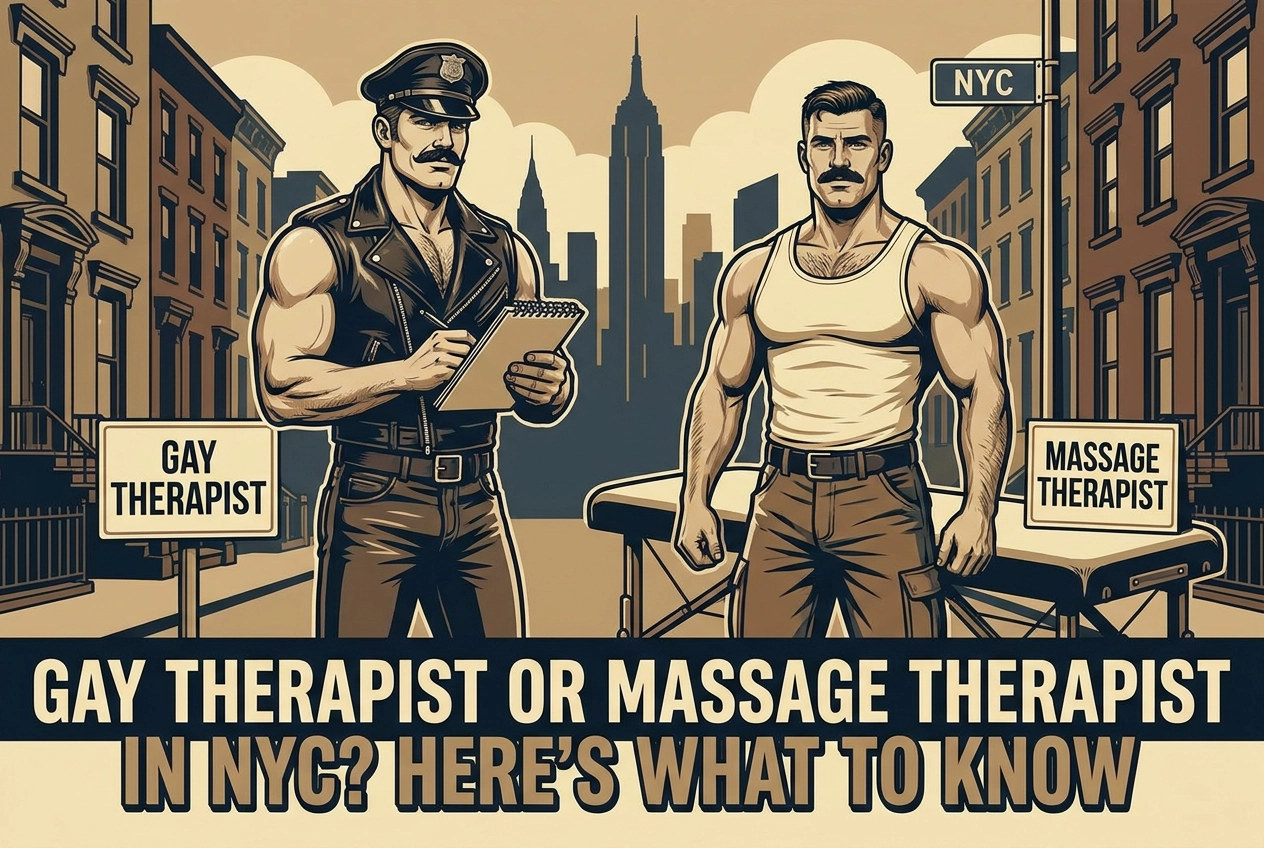
Gay Therapist or Massage Therapist in NYC? Here's What to Know
Looking for a gay therapist in NYC? Explore your options across talk therapy and licensed M4M massage — and find the right care for you.
By Menquility Team
Finding the right kind of support in a city as big and busy as New York can feel overwhelming, especially when you're not sure where to start. Whether you're looking for mental health support from a therapist nyc gay community members trust, or you're simply in need of some physical relief from a skilled massage therapist, knowing the difference and finding the right fit matters more than you might think.
New York City has no shortage of options, but more choices don't always make the decision easier. It can actually make things more confusing, particularly if you're new to therapy or wellness services altogether.
That's exactly why we put this guide together. In this post, we're breaking down everything a beginner needs to know, from understanding what each type of therapist actually does, to tips on finding LGBTQ+ affirming professionals who make you feel safe and seen. By the time you finish reading, you'll have a much clearer picture of what to look for and how to take that first step with confidence. Let's dive in.
What 'Gay Therapist in NYC' Actually Means (It Depends on What You Need)
If you've typed "gay therapist NYC" into a search bar, here's something worth knowing right away: that single search phrase actually points toward two completely different kinds of care, and both are legitimate.
The word "therapist" splits into two licensed categories in New York City. The first is mental health providers, including psychologists, licensed clinical social workers (LCSWs), and licensed marriage and family therapists (LMFTs). The second is licensed massage therapists, trained bodywork professionals who work with muscle, fascia, and the nervous system directly. Both categories have gay-affirming practitioners working in NYC right now, and both address real wellness needs.
Here's the thing: most people searching this phrase are in early-stage research mode. They haven't necessarily decided which type of care fits their situation yet. That's completely normal, and honestly, the search itself is usually a signal that someone is ready to do something, even if they're not sure what that something is yet.
The difference in what each modality actually does matters. Mental health therapy works with cognitive and emotional patterns, relational dynamics, internalized stress, and identity. Massage therapy works with the body directly, addressing somatic tension, nervous system regulation, and physical stress response.
For queer men, both categories share one important threshold question, explored well at NYC Affirmative Psychotherapy: will this provider understand my life without me having to explain it first? Whether you're on a therapy couch or a massage table, that question shapes the entire experience.
This post covers both honestly, and maps out where LGBTQ+ affirming care in New York fits each need, including why some gay men find the most benefit when both work together.
Gay-Affirming Mental Health Therapists in NYC: What the Landscape Looks Like
If you're looking for mental health support specifically as a gay or queer man in NYC, the landscape is actually pretty robust. Here's a breakdown of the main players and what to look for when choosing.
The Gay Therapy Center is one of the largest queer-specific mental health practices in the country. With over 40 LGBTQ psychologists and psychotherapists averaging 15 years of clinical experience, they operate across NYC, Los Angeles, San Francisco, and New York City. One thing that sets them apart is their personalized matching process. Rather than leaving you to scroll through a directory alone, they conduct intake consultations to connect you with a specific therapist whose background fits your needs.
Expansive Therapy, located at 352 7th Ave in Chelsea, is a 100% LGBTQIA+-owned practice where many therapists identify as gay or queer themselves. They focus on issues like shame, HIV stigma, queer identity, coming out, and relationship dynamics. Their therapists use advanced modalities including EMDR and Internal Family Systems (IFS), which are particularly effective for trauma work. If you've ever felt dismissed or subtly judged in a general therapy setting, this kind of specialist environment tends to feel meaningfully different.
For men who want peer-based support at a lower price point, IHI Therapy offers Gay Men's Psychotherapy Groups at just $55 per session. That's a practical entry point if individual therapy feels financially out of reach right now, or if you're simply not ready for one-on-one sessions.
When evaluating any mental health therapist, look beyond vague "inclusive" language. Specifically ask about their LGBTQ specialization, their direct experience with gay men's stressors, and which therapeutic modalities they use. Transparency here is a green flag.
Finally, talk therapy is the right tool when you're working through relational patterns, identity questions, trauma, grief, anxiety, or depression. If the root of what you're carrying is psychological, a licensed therapist is where to start.
Gay-Affirming Massage Therapists in NYC: A Different Kind of Care
Not all massage therapists are the same, and that distinction matters a lot when you're a gay or queer man looking for bodywork that actually feels safe.
Licensed massage therapists (LMTs) in New York State hold a state-issued credential that requires formal training, a licensing examination, and ongoing continuing education. This makes massage therapy a regulated, healthcare-adjacent profession. Not every provider you find on a directory carries that credential. Some independent listings mix licensed therapists with unlicensed practitioners, so it's worth asking directly before you book.
Beyond credentials, there's the affirming piece. Gay-affirming massage therapy isn't just a marketing phrase. It means your therapist understands queer body language, has no awkwardness or judgment around male touch or intimacy, and creates a space where you don't have to perform straightness or explain your relationship, your body, or your life before receiving care. As described in LGBTQ+ affirming bodywork practice, affirming therapists know how to use inclusive language, ask for your preferred terms, and stay attuned to the specific needs queer clients bring to the table.
Independent M4M therapists in NYC are scattered across Hell's Kitchen, Chelsea, Murray Hill, the Upper West Side, and the Theater District. The concentration is real, but so is the variability. When a therapist operates without a dedicated studio, the experience can shift significantly from session to session in terms of privacy, consistency, and whether their licensing is current.
Pricing in Manhattan reflects all of this. NYC is the highest-priced market for gay massage in the country. Independent therapists typically charge $120 to $200 for 60 minutes, $160 to $280 for 90 minutes, and $200 to $350 for two hours. That's already 20 to 30% above outer borough rates.
One more thing worth knowing before you book: platform apps add a 15 to 25% commission on top of whatever the therapist charges. Booking directly with a licensed provider or a dedicated studio cuts that surcharge entirely and builds a cleaner, more direct relationship with the person actually doing the work.
Why Gay Men Are Turning to Therapeutic Massage as Part of Their Wellness Routine
There's a real shift happening in how gay and bi men think about taking care of themselves, and it goes well beyond hitting the gym or the occasional haircut. Therapeutic massage is becoming a genuine part of the wellness conversation, and there are some pretty solid reasons why.
Your Body Keeps Score, Even When Your Mind Moves On
Years of navigating spaces that weren't built with you in mind leaves a mark. Body shame, hypervigilance in public, and the low-grade chronic stress of existing in hetero-normative environments all accumulate physically. Research into somatic therapy highlights how shame and disconnection from sexuality can create a literal sense of detachment from your own body, where your physical form feels at odds with who you actually are. Talk therapy is genuinely valuable, but it works cognitively. Therapeutic massage works at the level where that tension actually lives, in your nervous system, your muscles, and your physical sense of safety. Somatic therapy research specific to gay men describes this as working with "where shame, fear, or disconnection live in the body," which is something words alone can't fully reach.
Wellness for Men Now Includes Bodywork
Men's wellness in 2026 looks genuinely different from five years ago. Grooming, nervous system care, intentional physical recovery, and bodywork have joined gym routines as recognized forms of self-care, not indulgences. Gay wellness directories in NYC now organize providers across massage, holistic wellness, fitness, and therapy categories all under one umbrella, reflecting how integrated this thinking has become.
A Lower-Barrier First Step
Not every gay or bi man is ready for psychotherapy, and that's completely okay. A licensed gay-affirming massage session can be a softer entry point into intentional self-care. The environment matters enormously here. When a space is explicitly judgment-free and welcoming to gay, bi, and curious men, the anxiety of "will I have to explain myself here?" disappears entirely. That alone changes the experience.
The Science Backs It Up
Regular bodywork has documented effects on cortisol reduction, parasympathetic nervous system activation, and muscle recovery. Those benefits are real on their own. But they're meaningfully compounded when the therapeutic relationship itself is affirming rather than anxiety-producing. A tense, guarded client cannot fully drop into parasympathetic rest, no matter how skilled the therapist. The affirming environment and the physiological benefit reinforce each other.
Using Both at the Same Time
Some gay men find that massage and talk therapy work well together rather than as alternatives. Psychotherapy helps process emotionally; bodywork helps discharge the physical tension that accumulates between sessions and reinforces a felt sense of safety in the body. At a place like Menquility, that combination has a natural home, with licensed M4M therapists in a private suite, no walk-ins, and a space designed specifically so gay, bi, and curious men can genuinely let their guard down.
Menquility: A Licensed Gay-Owned M4M Massage Studio in Midtown Manhattan
If you're a gay, bi, or curious man in NYC looking for bodywork that actually feels built for you, Menquility is worth knowing about. Located in Midtown Manhattan, this queer-owned therapeutic massage spa was designed from the ground up with one specific client in mind: men who want care without having to explain themselves, perform straightness, or wonder if the person working on them gets it. The studio operates out of private suites, by appointment only, and the entire experience is structured around discretion and intentionality from the moment you book.
What's on the Menu
Every session at Menquility is delivered by a licensed M4M therapist, and the service menu gives you real flexibility depending on what your body and mind actually need that day. Modalities include Swedish, Deep Tissue, Hot Stone, Thai, Aromatherapy, and Nuru, with sessions available in 60, 90, and 120-minute lengths. That range matters. A 60-minute Swedish after a rough week hits differently than a 120-minute Deep Tissue after months of carrying tension in your shoulders. You're not locked into one option; you choose what fits.
Central to All of Manhattan
The Midtown location is genuinely convenient no matter where you're coming from. Whether you're based in Chelsea, Hell's Kitchen, Greenwich Village, Murray Hill, the Upper East or West Side, or the Financial District, Menquility sits in a central corridor that's easy to reach without a long commute cutting into your mental reset.
Bi and Curious Men Are Welcome Here
One thing that sets Menquility apart is that it explicitly names bi and curious men as part of its intended clientele, not just gay-identified clients. This is a gap that most wellness providers, both massage and mental health, haven't addressed directly. For men who are still navigating their identity or who simply don't want to label themselves before booking a massage, that kind of language matters.
To book, call or text +1 (646) 347-1740 or email concierge@menquility.com. The studio is open daily from 10am to 10pm, appointments only, no walk-ins. You can also browse the broader gay massage NYC landscape to get a sense of how Menquility fits within the larger scene.
What to Look for in Any Gay-Affirming Therapist in NYC (Massage or Mental Health)
Whether you're searching for a mental health therapist or a massage therapist, the same core checklist applies. Here are five things worth evaluating before you book anything.
1. Explicit identity alignment
There's a real difference between a provider who slaps "inclusive" on their website and one whose entire practice is built around queer clients. Look for providers who name gay men's experiences specifically, not just the broader LGBTQ+ umbrella. Do their intake forms avoid heteronormative assumptions? Do they mention non-monogamy, chosen family, or the specific stressors gay men navigate? Finding an LGBTQIA+-supportive therapist means finding someone whose affirmation is structural, not decorative.
2. Licensing and credentials
For mental health providers, verify LCSW, LMFT, LMHC, or PhD/PsyD licensure through the NYS Office of the Professions at op.nysed.gov. For massage therapy, confirm NYS LMT licensure through the same database. The NYC market includes unlicensed operators in both categories, and the risk is real, whether you're trusting someone with your mental health or your body.
3. Privacy and discretion infrastructure
Private suites, appointment-only scheduling, and discreet booking processes are not luxury extras. They're practical signals that a provider has seriously considered the experience of clients who may still be navigating stigma. Finding affirming mental health care requires intentional structural design, not accidental inclusion. A shared lobby or a walk-in model tells you something important about how much thought has gone into your comfort.
4. Transparent pricing
NYC gay massage rates range from $120 to $350 depending on session length and provider type. If a provider's pricing is buried, vague, or requires an inquiry just to find out, that's a red flag. Transparency about cost is a basic trust signal, especially in a premium market.
5. Lived or deep cultural familiarity
The best gay-affirming providers understand gay men's lives without needing a tutorial. Dating app culture, PrEP conversations, community grief, body image pressures specific to gay social spaces: a provider with genuine familiarity already knows these are part of the picture. LGBTQIA+ therapy matters most when the provider brings that context in with them, not after you've spent three sessions explaining your life.
Finding the Right Care in NYC Starts With Knowing What You Are Looking For
At the end of the day, getting this right comes down to one honest question: what kind of support do you actually need right now?
If what you're carrying is primarily emotional, relational, or rooted in past trauma, a licensed LGBTQ mental health therapist is the right starting point. Practices like Expansive Therapy and IHI Therapy are built specifically for this, with therapists who understand the lived experience of being a gay or queer man without requiring you to explain yourself first.
If what you're dealing with is more physical, think chronic tension, stress that lives in your body, or simply wanting a space where you can exhale completely without judgment, licensed M4M therapeutic massage is a real and effective wellness choice. It is not a lesser option. It is a different tool.
Many gay men find that both work well together. Bodywork and talk therapy are complementary, not competing. One works through language; the other works through the body. You do not have to choose.
For therapeutic massage in Midtown, Menquility offers a licensed, private, queer-owned studio built specifically for gay, bi, and curious men. Book directly at +1 (646) 347-1740 or concierge@menquility.com.
Whatever direction you go, choose a provider whose environment lets you show up as you actually are. That part is non-negotiable.
Conclusion
Finding the right support in New York City does not have to feel impossible. Here are the key takeaways to remember: a gay-affirming therapist addresses your mental and emotional health, while a massage therapist focuses on physical tension and body-based relief. Both serve important roles in your overall wellness. Knowing which one you need is the first step toward actually getting the help you deserve.
You also now know what to look for in LGBTQ+ affirming professionals, so you can feel safe, respected, and genuinely supported from day one.
Ready to take that first step? Start by identifying your most pressing need right now, whether it is mental health support or physical relief. Then use the tips in this guide to find a trusted professional in NYC. You deserve care that truly sees you.