Journal / August 2, 2026
The Best Deep Tissue Massage in NYC (And What Most Lists Won't Tell You)
Find the best deep tissue massage in NYC. A gay-affirming guide for men who want real results, licensed M4M therapists, and zero judgment.
By Menquility Team
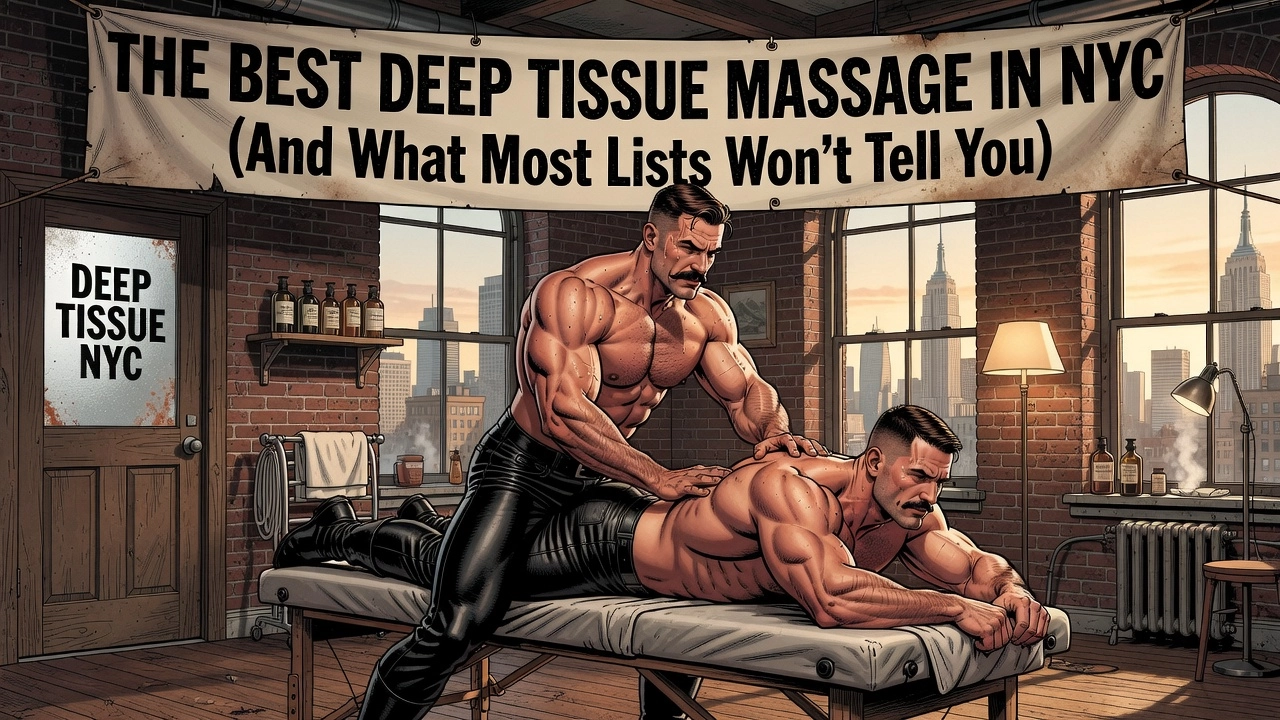
Finding the best deep tissue massage in NYC sounds simple until you realize most "best of" lists are little more than recycled Yelp roundups with zero real insight. You deserve better than that.
New York City has hundreds of massage studios, wellness spas, and independent therapists all claiming to offer elite deep tissue work. But deep tissue massage is a specific, technical modality. It requires trained hands, genuine pressure control, and a therapist who understands muscle anatomy, not just someone who pushes hard and calls it a day.
This guide cuts through the noise. Whether you are managing chronic tension from long hours at a desk, recovering from athletic training, or simply done with massages that barely scratch the surface, we have done the research for you. You will learn which NYC spots consistently deliver results, what separates a truly skilled deep tissue therapist from an average one, and the questions you should be asking before you book. No filler, no sponsored fluff. Just an honest, experience-informed breakdown of where to go when you need serious work done on serious muscle tension.
What to Actually Look For in a Deep Tissue Massage in NYC
Not every "deep tissue" booking in NYC delivers the same result. Before you commit your time, money, and body to a session, there are five concrete criteria worth running through, and most booking guides skip at least half of them.
1. Verify Licensing Before You Book
A valid New York State massage license is the baseline, not a bonus. NYS requires licensed massage therapists to complete accredited training and pass a licensing exam before practicing legally. Any studio or solo practitioner worth booking should display licensing information on their website or provide it on request. If that information is buried, vague, or absent entirely, keep scrolling.
2. Pressure Customization Is Non-Negotiable
"Firm" is not a modality. Real deep tissue work requires a therapist who can calibrate pressure to your specific tissue density, injury history, and session goals. Ask directly whether the therapist adjusts pressure throughout the session or applies a fixed intensity. A provider who cannot answer that question clearly is not offering therapeutic deep tissue, regardless of what the menu says.
3. The Queer-Specific Layer Most Lists Skip
Gay and bi men should not have to code-switch in the treatment room, over-explain their bodies, or silently wonder whether their therapist is comfortable with them. That cognitive load has a physiological cost: it keeps your nervous system alert when it should be releasing. M4M therapist availability and actively gay-affirming staff are legitimate therapeutic criteria. Research from the LGBTQ+ wellness community confirms that this preference is grounded in comfort, trust, and emotional safety, not indulgence. Demand for explicitly LGBT+-affirming practitioners is active and growing, even outside major metro markets.
4. Pricing, Duration, and Red Flags
NYC deep tissue sessions range from roughly $80 to $200+ per hour depending on format. First-time clients should budget for 90 minutes at minimum; 60 minutes is rarely sufficient for full-body chronic tension work. When reviewing any studio, screen for these red flags: vague modality menus that blur therapeutic and non-therapeutic intent, no licensing credentials visible on the website, and session descriptions that list "relaxation and deep tissue" without distinguishing between them. These are particularly relevant for queer men navigating a marketplace where terminology is inconsistent.
5. Environment Directly Affects Therapeutic Results
A private suite is not just a comfort upgrade. When your environment signals safety and discretion, your nervous system downregulates, cortisol drops, and your muscles can actually release at depth. A judgment-free setting has a direct physiological effect on what deep tissue work can accomplish. For gay and bi men especially, a spa that is built around your experience rather than merely tolerating it creates the conditions where real therapeutic outcomes become possible.
The Best Deep Tissue Massage Options in NYC
With the criteria from the previous section in mind, here are the strongest options for deep tissue massage in NYC for gay, bi, and queer men, ranked by overall fit across identity, technique, location, and accessibility.
1. Menquility (Midtown Manhattan)
Menquility is the only option on this list that combines queer ownership, an exclusively gay-affirming licensed therapist team, and a defined masculine brand identity under one roof. Established in 2025, the studio was built specifically for gay, bi, and curious men who want therapeutic results without the performance of pretending a generic spa feels welcoming. Deep tissue sessions run 60 to 120 minutes in private suites, with therapists trained to work with intention, not just pressure.
The spa operates daily from 10am to 10pm by appointment only, which means no walk-in crowds, no shared waiting rooms, and no ambiguity about the environment you are stepping into. The Midtown location puts it within easy reach of Chelsea, Hell's Kitchen, Greenwich Village, the Upper East and West Sides, and the Financial District, making it a realistic option regardless of which neighborhood you are coming from. For men who have settled for uncomfortable silences or surface-level inclusivity at mainstream spas, Menquility represents a genuinely different kind of session. Book via call or text at +1 (646) 347-1740, or email concierge@menquility.com.
2. Seasons Men's Spa (243 E 13th St, East Village)
Seasons Men's Spa is the closest structural equivalent to Menquility in terms of format. It operates as an LGBTQ+-inclusive M4M spa with deep tissue as a flagship service, offered alongside Swedish, Thai Yoga, and Shiatsu. The spa is open daily from 10am to 11pm, giving it a slight edge on late-evening availability. The therapist roster is framed around international bodywork traditions rather than queer identity specifically, which suits clients whose primary focus is technique variety and modality depth rather than an explicitly queer environment.
The East Village address at 243 E 13th St positions Seasons well for clients traveling from the Lower East Side, Union Square, or Gramercy. If you want a multi-modality M4M spa experience and you live or work on the east side of downtown Manhattan, Seasons is worth a serious look. Independent verification of current hours and service availability is recommended before booking, as the spa launched in December 2024 and operational details may continue to evolve.
3. East Men Spa NYC (344 E 16th St, East Village)
East Men Spa NYC self-describes as the number two gay spa in New York City and backs that positioning with one of the broadest modality menus in this segment: Deep Tissue, Shiatsu, Thai, Swedish, and Body Ceremony are all on offer. What sets it apart from a pure value standpoint is its VIP membership structure. After five visits, sessions drop to $50 per 60 minutes, making it the most cost-accessible option for regular clients in this category by a significant margin.
Located at 344 E 16th St, the spa is a strong fit for clients in the East Village, Gramercy, or Stuyvesant Town catchment areas. For gay men who want an explicitly gay-positioned spa environment without the premium price point of a first-visit-only rate, East Men Spa NYC rewards loyalty in a way that few competitors do. The VIP pricing alone makes this worth considering for anyone who plans to make therapeutic massage a consistent part of their routine rather than an occasional treat.
4. AlexSpot24
AlexSpot24 positions itself as a gay men's spa offering deep tissue massage alongside grooming and waxing services, which makes it the only option on this list that explicitly combines therapeutic bodywork with body grooming in a single appointment. The brand language emphasizes luxury, discretion, and specialized services for gay men, mirroring the confidentiality-forward tone common across this segment. For clients who want to consolidate a massage session and grooming appointment without bouncing between two separate bookings, this is the most efficient option available.
AlexSpot24 maintains an active blog presence targeting LGBTQ+ wellness content, which signals an established and seriously marketed practice. Specific pricing is not publicly listed, so prospective clients should reach out directly to confirm rates, availability, and location before scheduling.
5. DavidTouch (Midtown West, near Penn Station)
DavidTouch operates as a solo-practitioner model rather than a multi-therapist spa, offering deep tissue alongside tantric and sensual massage in a private studio near Penn Station. For clients who prefer a consistent one-on-one practitioner relationship over the rotating-therapist dynamic of a spa format, this structure has real advantages. Confidentiality is central to the messaging, and the Midtown West location gives it geographic overlap with Chelsea and Hell's Kitchen, two of the highest-density gay neighborhoods in Manhattan.
The active blog presence, with posts updated through late 2025, signals a practitioner who takes the practice seriously and communicates with clients beyond the booking page. Independent verification of availability and current services is recommended before booking, as solo-practitioner practices can shift more quickly than established spas.
6. GayWellness.com Directory Listings
GayWellness.com functions as a discovery layer rather than a spa. The directory aggregates certified NYC M4M practitioners offering deep tissue with verified reviews, which makes it useful for clients searching outside the East Village or Midtown corridors where most spa-format options are clustered. The breadth of the gay massage NYC listings on directories like Energy Men Spa and similar aggregators illustrates just how active the solo-practitioner side of this market has become in 2025 and 2026.
The caveat with any directory is that individual vetting remains the client's responsibility. Confirm licensure, read recent reviews carefully, clarify cancellation policies before committing, and prioritize practitioners who communicate clearly during the booking process. A five-star average means more when it is accompanied by substantive written reviews rather than ratings alone.
What Makes a Deep Tissue Session Truly Gay-Affirming
Gay-affirming deep tissue massage is not a branding decision. It is an operational one, and the difference shows up long before anyone's hands are on your back.
Beyond the Rainbow Flag
A website banner signals intention. What actually matters is whether the intake form asks questions you can answer without euphemism, whether the draping conversation is straightforward rather than cautious in a way that telegraphs the therapist's discomfort, and whether pressure check-ins feel like professional calibration rather than a liability script. Genuine affirmation means the therapist carries the relational labor so the client doesn't have to. You should not arrive at a deep tissue session already managing someone else's unfamiliarity with your body, your lifestyle, or your comfort level. That cognitive overhead is its own form of tension, and it does not release on the table.
Therapist Identity and Body-Awareness Context
An M4M therapist who is himself gay or queer brings a different quality of attunement to the work. He is less likely to misread physical guarding as simple tightness and more likely to recognize tension patterns that accumulate in gay men's bodies specifically: jaw, neck, and upper shoulder tension built from years of social hypervigilance; lower back and hip compression from sedentary knowledge-work layered over heavy gym training. These are not generic stress patterns. A therapist who shares the lived context is better positioned to read them accurately and work them effectively, without the client narrating his own anatomy in real time.
Trust Signals Worth Checking Before You Book
When evaluating a studio, look for gay-affirming or M4M language on the primary booking surface, not buried in a secondary About section. A clearly stated appointment-only model with private-suite confirmation is a meaningful signal. Licensed therapist credentials should be listed or available on request; New York State LMT licensure is the non-negotiable baseline. The booking channel itself matters: a direct call, text, or concierge email line reads very differently from an open scheduling platform with a public review trail. Directories like Gay Wellness NYC exist precisely because generic platforms do not sort by this standard.
The First-Timer Anxiety Gap
For queer men booking a therapeutic massage for the first time, discretion is not a premium feature. It is the threshold question. The booking process is the first affirming or alienating touchpoint, and how a studio handles that initial contact tells you everything about how the session itself will feel. A concierge-style phone answer, a response to a text that reads like a private communication rather than an auto-reply, a confirmation that references your appointment time without unnecessary detail: these are not small things. They are the evidence that the studio was designed with your actual experience in mind, not retrofitted to include you.
Why Deep Tissue Massage Specifically Works for Gay and Bi Men's Bodies
The Hypervigilance Tension Cluster
Gay and bi men carry a tension pattern that most generic spa menus are not built to address. Years of reading rooms, managing identity presentation, and navigating environments that require constant situational awareness embed chronic holding in a specific cluster: the jaw, the neck, the upper trapezius, and the occipital ridge at the base of the skull. This is not surface-level stress. It lives in the fascia and the belly of the muscle, and it does not respond to the light effleurage strokes that define a Swedish session. Deep tissue work, applied with sustained directional pressure to the fascial layers and muscle tissue rather than the superficial structures, is the clinical mechanism that actually reaches this holding pattern and begins to interrupt it. It is one of the most undertreated tension profiles in therapeutic massage, and one of the most common presentations in gay and bi male clients.
The Gym-and-Desk Double Bind
Gay male clients disproportionately combine rigorous gym training with knowledge-work desk jobs, and that combination produces a layered tension cocktail that no single lighter modality resolves cleanly. Training load creates anterior chain tightness: the chest, hip flexors, and anterior shoulder shorten and pull forward. Sustained desk posture loads the posterior chain: the lumbar, mid-back, and posterior shoulder accumulate compensatory tension from hours of sitting. The result is a body pulling against itself from both directions. Deep tissue is uniquely suited to address both sides of this equation within a single session, working through the anterior restrictions from training while releasing the posterior holding from posture. Swedish addresses neither adequately; hot stone addresses neither at all.
Why 60 Minutes Often Falls Short
A 60-minute deep tissue session is appropriate for targeted spot work, addressing the lower back only, or the neck and shoulders only. It is not adequate for the systemic release that most clients in this population are actually seeking. When a session needs to work through both the hypervigilance tension cluster and the gym-desk tension profile, the tissue requires time: time to warm, time to respond, and time for the therapist to move methodically through multiple regions without rushing transitions. A 90 to 120-minute session is the clinical minimum for full-body work that addresses both profiles. Booking 60 minutes and expecting whole-body relief is one of the most common mismatches between what clients schedule and what their bodies actually need.
Where Deep Tissue Sits Among the Modalities
The M4M deep tissue providers listed across NYC directories offer a wide modality menu, and understanding where each one fits matters before you book. Swedish is the right choice for relaxation, circulation improvement, and nervous system reset. Thai and Shiatsu are better suited for flexibility work, range of motion, and energy-line release. Hot stone delivers surface warmth, mood elevation, and light circulatory benefit. Deep tissue is the clinical anchor: it breaks up adhesions, releases fascial restriction, and addresses the chronic muscular holding patterns that accumulate over months and years. If your primary complaint is that you carry all your stress in your shoulders, your neck, or your back, the other modalities will offer temporary relief at best. Deep tissue is the modality that addresses the structural source.
After Your Deep Tissue Session: What to Expect and How to Recover
1. Expect 24–48 Hours of Soreness — That Means It Worked
Deep tissue work breaks up fascial adhesions and triggers a localized inflammatory response as part of the tissue repair process. You should expect muscle soreness comparable to a moderate workout, peaking somewhere around 12–24 hours post-session and clearing within 48 hours. This is the body's repair mechanism running on schedule, not a signal that the therapist pressed too hard or that something went wrong. If you left your session feeling like your shoulders finally dropped an inch, the soreness the next morning is confirmation the work landed where it was supposed to.
2. Hydration Is Non-Negotiable
Metabolic byproducts mobilized from worked muscle tissue clear through the lymphatic system and kidneys. That process needs water to run efficiently. Aim for at least 2–3 liters in the 24 hours following your session. Alcohol in the same window blunts the clearance process and amplifies soreness, so hold off until recovery is complete. This is practitioner-consensus guidance backed by basic physiology, not spa marketing.
3. Move Gently, Not Hard
A 10-minute walk or light stretch sequence in the 24 hours post-session keeps circulation moving through treated tissue and supports the clearance the massage initiated. Complete rest slows that process. Returning immediately to heavy gym training risks re-injuring tissue that is actively repairing. Recovery sits in the middle: gentle movement, not inertia and not a PR attempt.
4. Match Your Booking Cadence to Your Goals
Clients managing chronic neck, back, or shoulder tension typically see compounding results with sessions every 2–3 weeks for the first 6–8 weeks before shifting to a monthly maintenance schedule. Clients booking for general wellness and stress management can usually sustain results on a monthly or every-six-weeks cadence. Menquility's 60 to 120 minute session range and daily availability from 10am to 10pm make both schedules practical without the calendar friction that causes most clients to drop off before the compounding benefits accumulate.
Book the Session Your Body Has Been Waiting For
The best deep tissue massage in NYC is not just about finding a therapist who can apply pressure. It is about walking into a room where you are the intended client, not an accommodation. That distinction matters clinically: research published in 2025 found statistically significant gender differences in perceived massage effectiveness, confirming that comfort level and environmental alignment directly shape outcomes. When your nervous system trusts the room, the work goes deeper.
Menquility — Kips Bay, Manhattan NYC. By appointment only. Contact the concierge for arrival details.
Before you book, decide your session length:
- 60 minutes: Targeted spot relief for one or two problem zones
- 90 minutes: General chronic tension; the most versatile maintenance option
- 120 minutes: Full-body work or first sessions with significant accumulated tension
After your session, hydrate heavily, move gently, and allow 48 hours before your next hard gym session to let the tissue remodeling settle.
Book by calling or texting +1 (646) 347-1740 or emailing concierge@menquility.com. Your body has earned this.
Conclusion
Finding a truly exceptional deep tissue massage in NYC comes down to a few non-negotiables: knowing what the modality actually requires, choosing therapists with real technical training, and asking the right questions before you ever get on the table. Not every highly rated spot delivers genuine deep tissue work, and pressure alone does not equal skill.
You now have the knowledge to stop settling for mediocre sessions and start investing in bodywork that actually moves the needle on your pain, tension, and recovery.
Do not book blindly. Use the insights from this guide to vet your next therapist, trust your instincts during the session, and hold your expectations high. Your body does the hard work every single day. It deserves care that meets that effort. Now go book a massage worth remembering.